Category archive

Local Government & Agencies - page 73

Update (5/5/20): 1 Additional Clinton County Resident Has Tested Positive For COVID-19, Brings Total To 65
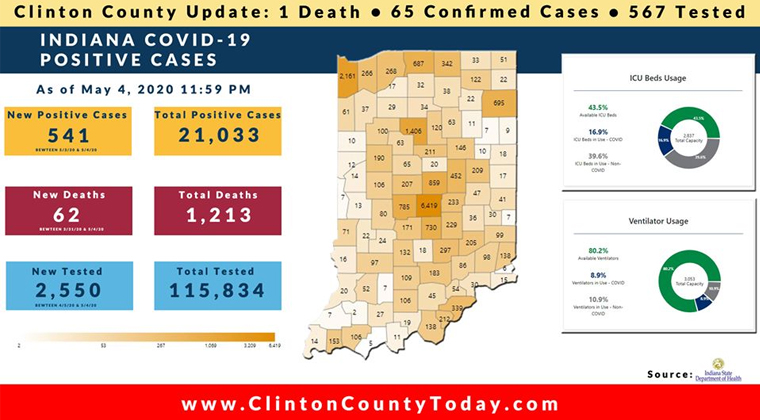
The Indiana State Department of Health (ISDH) announced today, Tuesday, May 5, 2020, Clinton County has now had 65 residents test positive for COVID-19. The one (1) new case reported was a female in the (40-49) age group. There is 1 death related to COVID-19 in Clinton County. At least 567 residents of Clinton County have been tested as reported by the ISDH.

Additionally, the ISDH announced that 541 additional Hoosiers have been diagnosed with COVID-19 through testing at ISDH, the Centers for Disease Control and Prevention (CDC) and private laboratories. That brings to 21,033 the total number of Indiana residents known to have the novel coronavirus following corrections to the previous day’s total.

A total of 1,213 Hoosiers have died to date. Deaths are reported based on when data are received by ISDH and occurred over multiple days.

To date, 115,834 tests have been reported to ISDH, up from 113,297 on Monday.

Frankfort Utility Service Board Provides IDEM Guidance for Flushing Water Systems

During the Monday, May 4, 2020, USB Meeting, the Indiana Department of Environmental Management guidance to re-opening buildings that may have been temporarily shut down or used less frequently over the last several weeks due to COVID-19 pandemic was shared.

Here is the link to download the complete document in pdf format:
https://www.in.gov/idem/cleanwater/files/dw_guidance_flushing_systems.pdf

Below is the text of the document:

This document is designed to help public water systems prepare their systems for safe use once they reopen buildings that may have been temporarily closed or used less frequently due to the COVID-19 pandemic. It is imperative that operators adhere to the flushing instructions below to ensure their indoor plumbing is receiving fresh water and not stagnant water. The flushing instructions apply to:

• Community water systems such as municipal water supplies, subdivisions, or mobile home parks
• Non-transient non-community water systems such as schools, daycares or factories
• Transient water systems such as churches, restaurants/bars or campgrounds

Issues Caused by Stagnant Water

When water is not used over an extended period, it will become stagnant. Stagnant or standing water can cause conditions that increase the risk for growth and spread of Legionella and other harmful biofilmassociated bacteria. When water is stagnant, hot water temperatures can decrease to the Legionella growth range (77–108°F, 25–42°C). Stagnant water can also lead to low or undetectable levels of disinfectants such as chlorine and could also cause corrosion issues. It is critical to ensure water systems are safe to use after a prolonged shutdown to minimize the risk of Legionnaires’ and other diseases associated with stagnant water.

How to Remove Stagnant Water

Since stagnant water is a potential health risk and can impact water quality, it is necessary to systematically flush the plumbing. In general, flushing involves opening taps and other fixtures and letting water run to remove any stagnant water within plumbing and fixtures. To protect the health and safety of consumers, IDEM recommends that you carefully read and adhere to the following instructions, which provide a systematic approach for conducting a complete flush.

NOTE: Some buildings have water treatment systems and those treatment devices need to be cleaned, flushed, and maintained as part of the start-up process. After flushing, water filters need to be replaced. If there is a point-of-entry water treatment system such as a water softener or filter, please refer to the instruction manual for information on how to replace the filter.

Flushing Instructions

Please complete these steps in the order set out below. Finish each step completely before moving on to the next step. During the initial flushing, it is a good idea to wear protective respiratory equipment. Discoloration and a lingering odor may occur during flushing; these issues are expected and are not a health issue.

1. Flush ALL cold water taps for at least 5 minutes.

Begin the cold water flushing procedure. Open ALL cold-water fixtures and run them for at least 5 minutes. Shut the water off after 5 minutes. Flush each toilet at least one time. This step includes the water in your refrigerator water dispenser.

Flushing should begin at the water service entrance and proceed through the building to the end points of the plumbing system in the building(s). Depending on flow and pressure, you may need to increase the flushing time to ensure all stagnant water has been flushed.

2. Flush ALL hot water taps for 15 minutes.

Once the cold water lines have been flushed, begin the hot water flushing procedure. Open ALL hot water taps in your bathroom(s) including lavatory (sink) fixtures, hot water bath fixtures, and any other hot water fixtures such as kitchens, wet bars, etc. Run these hot water fixtures for at least 15 minutes. Shut the water off after 15 minutes. Depending on the size of the hot water tank, you may need to flush longer to ensure the water in the tank has drained and fresh water has refilled the tank. These steps should be effective at removing contaminants from the water heater. However, for information on draining and cleaning the water heater, please consult the manufacturer.

3. Flush ALL remaining appliances and faucets for 5 minutes.

Open any remaining fixtures such as hose bibs, external faucets, or fixtures not used for drinking for at least 5 minutes to finish the plumbing system flushing. Take additional steps to remove water from other appliances including:

• Ice Makers
• Dishwashers
• Washing Machines
• Humidifiers
• CPAP Machines
• Oral, Medical, or Health Care Devices
• Baby Formula
• Water Filters
• Water Softeners
• Filters (point of use and whole house)

Remove ice from the ice maker bin and discard 2 additional batches of ice. Run empty dishwasher and washing machine once on rinse cycle.

4. Perform periodic ongoing flushes.

Periodic flushing is important to maintain water quality. Full-building, periodic flushes proceed the same as the initial flush except water tanks do not need to be drained and hot water flushing times are the same as cold water flushing times.

If you have chlorinated water, it is a good idea to measure chlorine residual during periodic flushes.

For additional COVID-19 response information that is more detailed, please visit:
https://engineering.purdue.edu/PlumbingSafety/project

Other Resources
• Guidance for Building Water Systems (Centers for Disease Control and Prevention)

https://www.cdc.gov/coronavirus/2019-ncov/php/building-water-system.html

• Return to Service Guidance (American Water Works Association)

https://www.awwa.org/Resources-Tools/Resource-Topics/Coronavirus#10681543-shutoffs-and-return-to-service-guidance

Frankfort Mayor Announces City Services Will Resume Gradually

Following the announcement of Governor Holcomb’s roadmap to reopen Indiana, and the Clinton County Commissioners decision to lift the Clinton County Travel Advisory, Mayor Judy Sheets announced that several city departments will begin plans to loosen COVID-19-related restrictions but says, “this does not mean people should act as though the danger of contracting COVID-19 has passed. Residents should continue practicing social distancing, wear masks, and frequently wash their hands in order to prevent an increase in cases.”

Mayor Sheets said having 17 new COVID-19 cases reported in Clinton County between May 2 and May 4 “is very concerning to us. We want to make sure that any action taken by the city to reduce restrictions is balanced with caution and awareness that increasing personal interactions between employees and the public could result in an increase in cases of Covid-19.”

Starting today, Frankfort Street Department will resume bulk item drop-off and collection. Recycling items, excluding glass, can also be dropped off at the Street Department.

Frankfort Fire Department will resume fire inspections this week by appointment only.

City playgrounds, Skate Park, and basketball courts are scheduled to reopen May 24.

The Police Department lobby will reopen on June 1.

Frankfort City Council and Board of Works have been holding their twice-monthly meetings virtually and live-streaming on YouTube. The May 11 meetings will still be held virtually.

While all city offices remain open for business, residents are asked to continue calling each department to schedule an appointment before visiting the offices in person. Phone numbers for each department can be found on the city website at https://www.frankfort-in.gov.

8 Additional Clinton County Residents Test Positive For COVID-19, Brings Total To 64

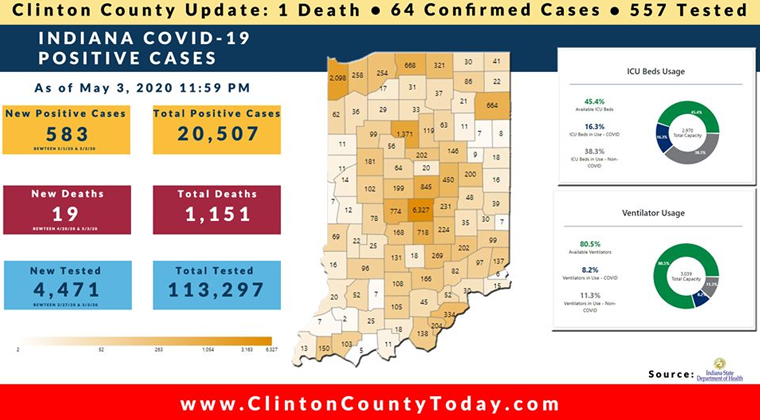
The Indiana State Department of Health (ISDH) announced today, Monday, May 4, 2020, Clinton County has now had 64 residents test positive for COVID-19. The eight (8) new cases reported consists of five (5) males and three (3) females. Of the five (5) males, two (2) are in the (30-39) age group, two (2) are in the (40-49) age group, and one (1) in the (20-29). Of the three (3) females, two (2) are in the (50-59) age group and one (1) in the (20-29) age group. There is 1 death related to COVID-19 in Clinton County. At least 557 residents of Clinton County have been tested as reported by the ISDH.

Additionally, the ISDH announced that 583 additional Hoosiers have been diagnosed with COVID-19 through testing at ISDH, the Centers for Disease Control and Prevention (CDC) and private laboratories. That brings to 20,507 the total number of Indiana residents known to have the novel coronavirus following corrections to the previous day’s total.

A total of 1,151 Hoosiers have died to date. Deaths are reported based on when data are received by ISDH and occurred over multiple days.

To date, 113,297 tests have been reported to ISDH, up from 108,859 on Sunday.

9 Additional Clinton County Residents Test Positive For COVID-19, Brings Total To 56

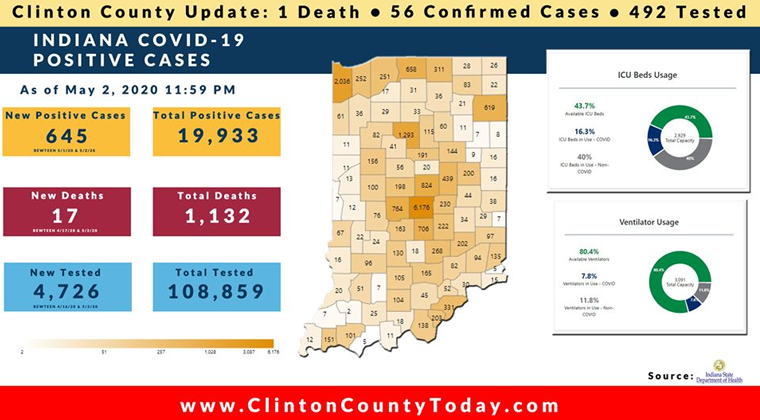
The Indiana State Department of Health (ISDH) announced today, Sunday, May 3, 2020, Clinton County has now had 56 residents test positive for COVID-19. The nine (9) new cases reported consist of eight (8) males and one (1) female. Of the eight (8) males, two (2) are in the (20-29) age group, two (2) in the (30-39) age group, two (2) in the (40-49) age group, and one (1) each in the (50-59) and (60-69) age groups. The one (1) female is in the (50-59) age group. There is 1 death related to COVID-19 in Clinton County. At least 492 residents of Clinton County have been tested as reported by the ISDH.

Additionally, the ISDH announced that 645 additional Hoosiers have been diagnosed with COVID-19 through testing at ISDH, the Centers for Disease Control and Prevention (CDC) and private laboratories. That brings to 19,933 the total number of Indiana residents known to have the novel coronavirus following corrections to the previous day’s total.

A total of 1,132 Hoosiers have died to date. Deaths are reported based on when data are received by ISDH and occurred over multiple days.

To date, 108,859 tests have been reported to ISDH, up from 104,141 on Saturday.

2 Additional Clinton County Residents Test Positive For COVID-19, Brings Total To 47

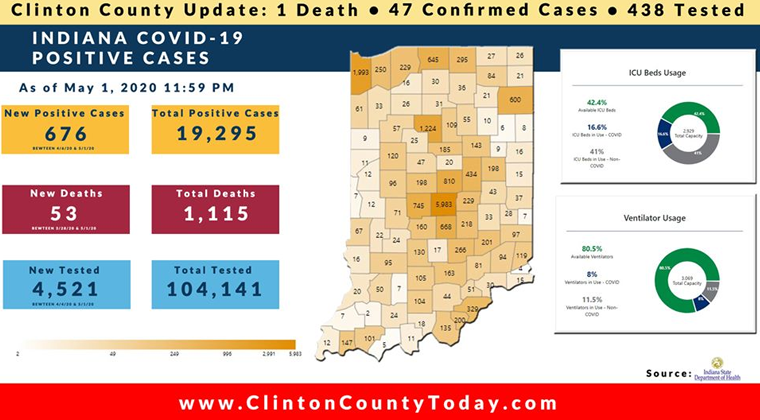
The Indiana State Department of Health (ISDH) announced today, Saturday, May 2, 2020, Clinton County has now had 47 residents test positive for COVID-19. The two (2) new cases reported include a previously unreported case from April 26, 2020. Of the 2 new cases, 1 is a female and 1 is a male. The 1 female is in the (40-49) age group. The male (case from April 26) is in the (40-49) age group. There is 1 death related to COVID-19 in Clinton County. At least 412 residents of Clinton County have been tested as reported by the ISDH.

Additionally, the ISDH announced that 676 additional Hoosiers have been diagnosed with COVID-19 through testing at ISDH, the Centers for Disease Control and Prevention (CDC) and private laboratories. That brings to 19,295 the total number of Indiana residents known to have the novel coronavirus following corrections to the previous day’s total.

A total of 1,115 Hoosiers have died to date. Deaths are reported based on when data are received by ISDH and occurred over multiple days.

To date, 104,141 tests have been reported to ISDH, up from 99,639 on Friday.

7 Additional Clinton County Residents Test Positive For COVID-19, Brings Total To 45

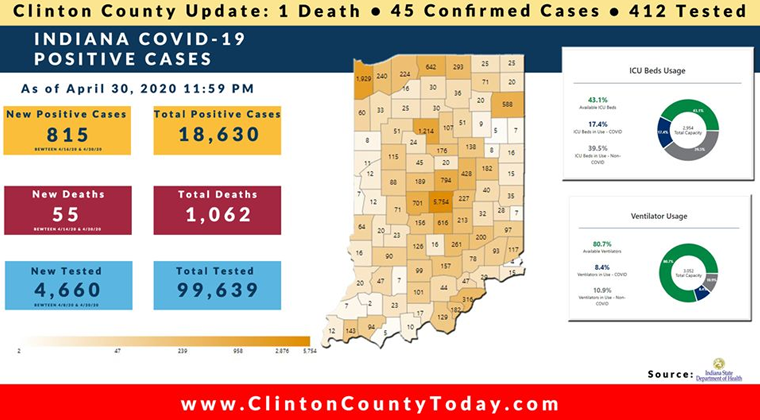
The Indiana State Department of Health (ISDH) announced today, Friday, May 1, 2020, Clinton County has now had 45 residents test positive for COVID-19. The seven (7) new cases reported include a previously unreported case from April 29, 2020. Of the 7 new cases, 5 are females: 3 in the (30-39) age group, 1 in the (20-29) age group and 1 in the (0-19) age group). 1 male in the (60-69) age group. The remaining case is from April 29 and is labeled as unknown in the (30-39) age group. There is 1 death related to COVID-19 in Clinton County. At least 412 residents of Clinton County have been tested as reported by the ISDH.

Additionally, the ISDH announced that 815 additional Hoosiers have been diagnosed with COVID-19 through testing at ISDH, the Centers for Disease Control and Prevention (CDC) and private laboratories. That brings to 18,630 the total number of Indiana residents known to have the novel coronavirus following corrections to the previous day’s total.

A total of 1,062 Hoosiers have died to date. Deaths are reported based on when data are received by ISDH and occurred over multiple days.

To date, 99,639 tests have been reported to ISDH, up from 94,998 on Thursday.

2 More Clinton County Residents Test Positive For COVID-19, Brings Total To 38

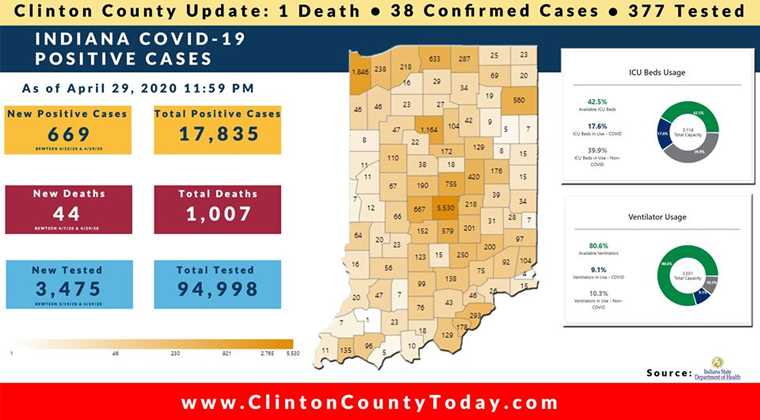
The Indiana State Department of Health (ISDH) announced today, Thursday, April 30, 2020, Clinton County has now had 38 residents test positive for COVID-19. The two (2) new cases are both males. One (1) in the (20-29) age group, the other in the (40-49) age group. There is 1 death related to COVID-19 in Clinton County. At least 377 residents of Clinton County have been tested as reported by the ISDH.

Additionally, the ISDH announced that 669 additional Hoosiers have been diagnosed with COVID-19 through testing at ISDH, the Centers for Disease Control and Prevention (CDC) and private laboratories. That brings to 17,835 the total number of Indiana residents known to have the novel coronavirus following corrections to the previous day’s total.

A total of 1,007 Hoosiers have died to date. Deaths are reported based on when data are received by ISDH and occurred over multiple days.

To date, 94,998 tests have been reported to ISDH, up from 91,550 on Wednesday.

1 More Clinton County Resident Test Positive For COVID-19, Brings Total To 36

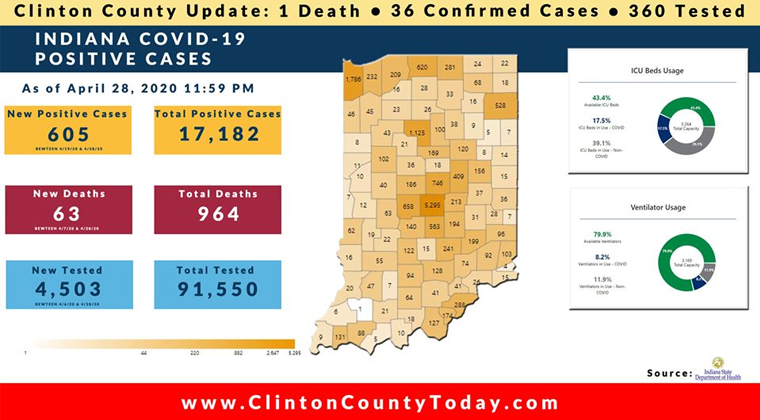
The Indiana State Department of Health (ISDH) announced today, Wednesday, April 29, 2020, Clinton County has now had 36 residents test positive for COVID-19. The one (1) new case is a female in the (40-49) age group. There is 1 death related to COVID-19 in Clinton County. At least 360 residents of Clinton County have been tested as reported by the ISDH.

Additionally, the ISDH announced that 605 additional Hoosiers have been diagnosed with COVID-19 through testing at ISDH, the Centers for Disease Control and Prevention (CDC) and private laboratories. That brings to 17,182 the total number of Indiana residents known to have the novel coronavirus following corrections to the previous day’s total.

A total of 964 Hoosiers have died to date. Deaths are reported based on when data are received by ISDH and occurred over multiple days.

To date, 91,550 tests have been reported to ISDH, up from 87,181 on Tuesday.

3 More Clinton County Resident Test Positive For COVID-19, Brings Total To 35

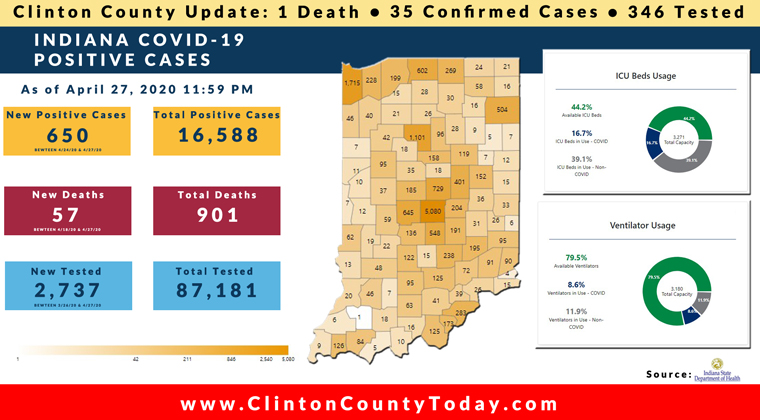
The Indiana State Department of Health (ISDH) announced today, Tuesday, April 28, 2020, Clinton County has now had 35 residents test positive for COVID-19. There is 1 death related to COVID-19 in Clinton County. At least 346 residents of Clinton County have been tested as reported by the ISDH.

Additionally, the ISDH announced that 650 additional Hoosiers have been diagnosed with COVID-19 through testing at ISDH, the Centers for Disease Control and Prevention (CDC) and private laboratories. That brings to 16,588 the total number of Indiana residents known to have the novel coronavirus following corrections to the previous day’s total.

A total of 901 Hoosiers have died to date. Deaths are reported based on when data are received by ISDH and occurred over multiple days.

To date, 87,181 tests have been reported to ISDH, up from 84,706 on Monday.

1 71 72 73 74 75 80
Go to Top