Frankfort, Ind. (September 29, 2025) – The air in Clinton County, usually thick with the scent of agriculture and the rhythm of rural life, is now buzzing with a different kind of current: the promise of a digital revolution. Doug Swain, a seasoned developer with a vision as expansive as the Indiana cornfields, stands at the forefront, pitching a future where Frankfort isn’t just a dot on the map, but a nexus of quantum computing and artificial intelligence. But like any bold venture, this one comes with a chorus of questions, concerns, and a healthy dose of skepticism from a community wary of trading their peace for progress.
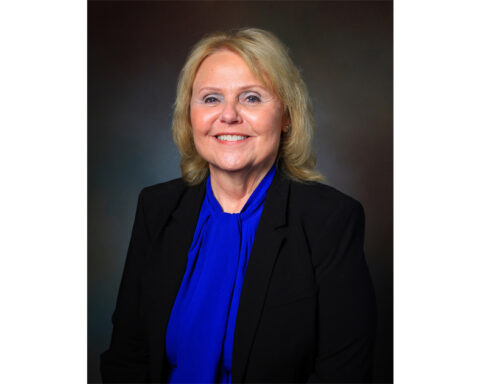
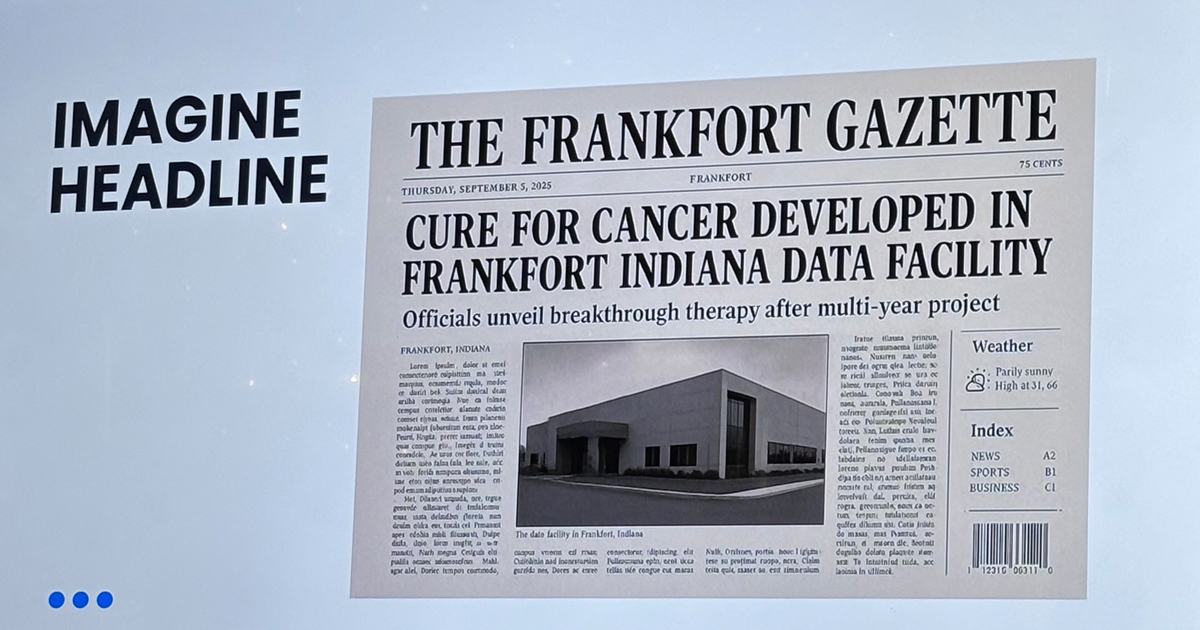
Swain, president of Logistix, who at a recent public gathering held at Willow Creek Barn on September 15th, shared his vision on the rezoning of 154 acres north of ConAgra for a massive data center development. His pitch isn’t just about servers and fiber optics; it’s about a headline-grabbing future: “Cure for cancer developed in Frankfort, Indiana data facility.” While he admits this won’t happen next year, he puts forward that as AI evolves into quantum computing, these facilities are “widely expected to generate cures for some widely known diseases, medical advances, advanced technology.” It sounds like science fiction, but Swain insists it’s “not really beyond the realm of possibility.”
The Hum of Progress: A Vision of Prosperity
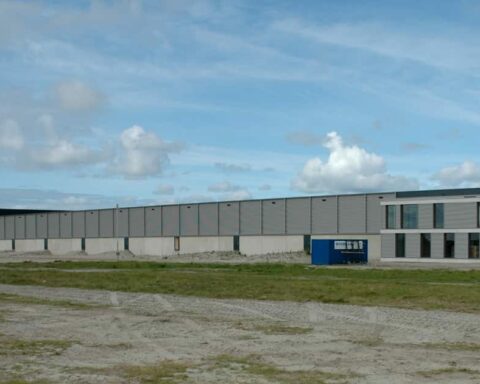
What exactly are data centers? Swain describes them as being “most like industrial warehouses” but housed with “a lot of processing units, GPUs, CPUs” that process vast amounts of data. They are the silent powerhouses behind everything from your daily ChatGPT query to cloud services like Google, Apple, and Facebook. The companies involved are “hyperscalers” like Amazon (AWS), Meta (Facebook), Google, and Microsoft, or “collocation” facilities serving multiple enterprise users. These are not small players; companies like Digital Realty boast market caps of $56 billion.
The economic promise, according to Swain, is substantial. An economic impact analysis, based on similar projects, projects nearly $1.5 billion invested to build 1.4 million square feet. Over a quarter-century, this could generate $265 million in gross property taxes and $6.3 million in new local income taxes. The project is slated to create 170 direct full-time positions within the data center, with an average wage of $85,000, almost 40% higher than Indiana’s average. Beyond that, over 300 indirect jobs and a thousand-plus construction jobs are anticipated.
“This is a new industry sector to Indiana that’s already advanced elsewhere in the country, and we have a chance now to change our game,” quoted a director of economic development from Morgan County, Indiana, describing a similar project. Swain points to examples in Hamilton and New Albany, Ohio, where mayors and economic directors lauded “significant” economic impact, “real growth not just in jobs but in the tax base.”
Furthermore, the proposed site lies within a TIF (Tax Increment Financing) district, meaning the generated property tax revenue could be funneled by the county’s redevelopment commission into infrastructure that supports housing development, a critical need exacerbated by property tax reductions from Senate Bill One. This, Swain believes, would encourage data center employees, who require 24/7 proximity to their work, to live locally.
Beyond the raw numbers, these companies are presented as committed community partners. Google, for instance, has given over $14 million in philanthropic grants in Ohio, focusing on STEM education and workforce development. AWS and Microsoft have similar programs, aiming to train local talent for high-paying tech jobs that are “expected to be there for a long long time.”
“We think it’s a game changer for the community,” Swain concludes, envisioning “quality development,” “high paying jobs,” and a “clean industry” that will lead to “other housing, retail, other opportunities” while maintaining Frankfort’s charm.
Shadows of Uncertainty: The Community’s Unanswered Questions
But the vision of a gleaming digital future casts long shadows of concern for Frankfort’s residents. At a public meeting, the mood was tense, with one resident openly declaring, “You sound like a used car salesman. I’m not buying your car.” The skepticism is palpable, rooted in fears about resources, health, and the unknown.
The Power Problem: A central concern revolves around energy. While Swain assures that the project will be powered by a dedicated transmission line and a 15-year-plus power agreement, with no costs anticipated to be borne by the community for utilities. Residents recall comments from Indiana’s governor about power grid strain and the possibility of nuclear reactors. Swain swiftly dismisses the nuclear option as “extremely expensive” and “not practical,” citing heavy regulation and logistical challenges. He clarifies that the grid is heavily regulated by MISO (Midcontinent Independent System Operator) to prevent strain and that utility companies are actively seeking clean energy solutions like natural gas and fuel cells to supplement the grid. Rick Gunyon, a Frankfort Utility Service Board member, corroborates this, stating, “We have more than enough electrical energy available for this data center and then some well into the future.” The location even offers redundancy with two different electric companies, Frankfort Municipal Power and Tipmont, and the option for natural gas generators as backup.
The Water Worry: “We hear a lot about the water,” Swain concedes, acknowledging widespread concerns. Residents are troubled by reports of data centers consuming “a million gallons or 2 million gallons a day.” Swain argues that these figures are based on older designs. The current “trend in data centers is to move away from these water intensive towers towards more sustainable closed loop system that recirculates and reuses the water,” with a goal of “near zero” water utilization. He cites examples like Vantage and Aligned data centers that use “highly efficient closed loops water systems” or “waterless cooling technologies.” However, residents question if these advanced systems will definitively be implemented in Frankfort and what happens during hot summer days. There’s also anxiety about potential aquifer depletion, especially for those outside city water limits who rely on private wells. Swain states they are working with the city and county to ensure comfort with water usage, and the utility company will monitor and ensure capacity isn’t harmed.
The Noise Nuisance: Another significant concern is constant noise. Residents report that similar facilities in other towns cause “non-stop” noise, leading to health issues like “anxiety and thousands of people” and even physical illness. Swain’s proposal suggests a 65 dB noise level, which he equates to “street traffic when you’re standing on a corner.” Mitigation efforts include increased setbacks, landscaping, and mounting around residences.
Jobs and Tax Breaks: The promise of 170 direct jobs is met with skepticism, with one resident claiming centers house only “12 to 50” people. Swain clarifies that 170 is for a fully operational facility of this specific type, not smaller enterprise data centers. The idea of “thousand plus construction jobs” is also questioned, given the common practice of bringing in out-of-state specialized contractors. Swain counters that while general contractors might be from out of town, they employ local staff and subcontractors for various trades, and workers will spend money in the local economy.
The mention of tax incentives further fuels resident frustration. While the state offers a “data center sales tax exemption” for 25-50 years on equipment, local property tax abatements are also on the table. Residents question how the community will benefit if these centers receive substantial tax breaks, essentially “stealing from us anyway” regarding state sales tax. Swain explains that local property tax abatements (typically 10 years, 50% reduction) are a local decision and part of a competitive landscape to attract investment. He reiterates the TIF district’s role in local infrastructure development as a primary benefit.
Transparency and Health: The “chicken and egg” problem of requiring zoning approval before revealing a specific buyer deeply frustrates residents, who want to “know before they make the vote.” Concerns about potential health issues, including cancer among workers and nearby residents, were also voiced, though Swain said he had “not seen any information” on such concerns with data centers.
A Community at a Crossroads
Rick Gunyon, the utility board member and long-time resident, offers a historical perspective, reminding the community of past anxieties about new technologies like McDonald’s or the railroad. “We’ve had this conversation before. The subjects have changed over the years and it’s very natural for everyone to have different points of view of this,” he says, encouraging “suspension of disbelief” and seeing the project as an opportunity.
Doug Swain and his team are attempting to navigate a complex landscape, balancing the allure of a high-tech, high-revenue future with the deep-seated concerns of a community clinging to its character. The meetings are ongoing, the questions are plentiful, and the answers are, for many, still insufficient. Frankfort, like many communities across the country, stands at a crossroads, weighing the tangible risks against the tantalizing promise of the digital frontier. Whether it’s a cure for cancer or simply a new economic engine, the decision will shape the community’s identity for decades to come.
Next Up
The Clinton County Commissioners will have the final say on the rezoning request. By Indiana law, the commissioners were presented with the Area Plan Commission’s “neutral” recommendation at its September 16th meeting and have 90-days to make a decision. Commissioners president Jordan Brewer stated that the topic will come up at either the first or second meeting in October. His remarks came while speaking to community member at Paul Phillippe Resource Center on September 10th.
The commissioners are next scheduled to meet on October 7th at 9am in the Courthouse.