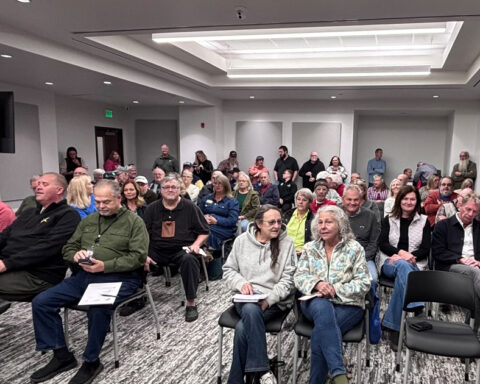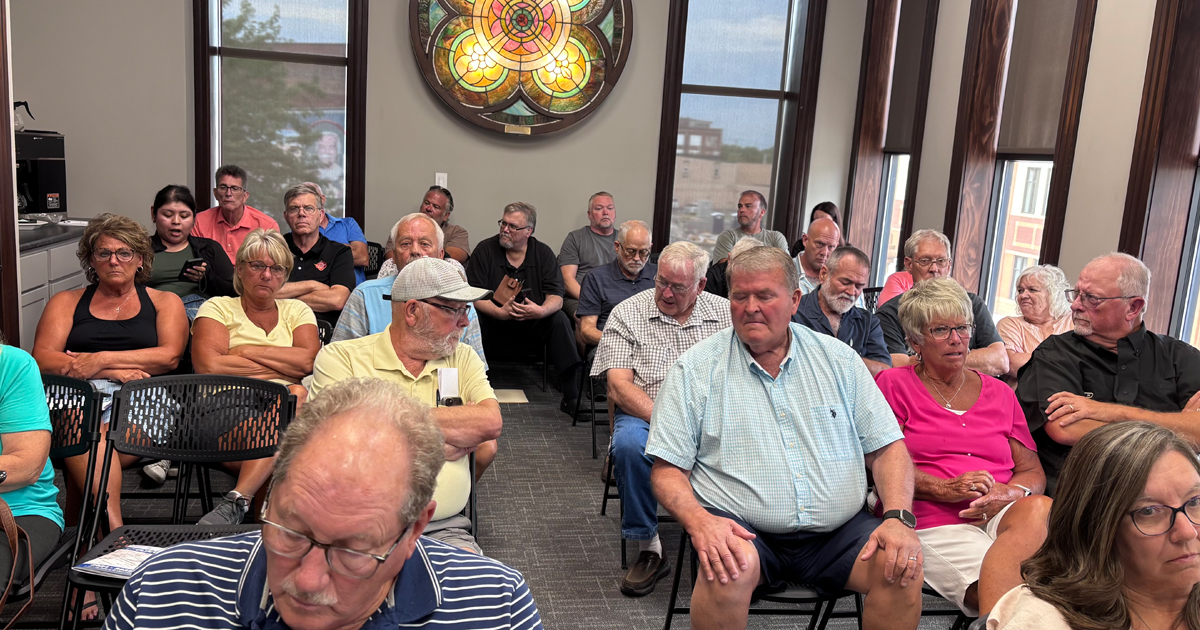
FRANKFORT, Ind. (July 15, 2025) — Members of the Frankfort and Clinton County community filled the second floor conference room of the Iron Block building tonight to hear from and ask questions of developers that are proposing a large-scale data center project spanning over 700 acres in Frankfort, with an estimated total investment exceeding $10 billion.
The project, spearheaded by Logistix, aims to bring significant economic benefits to Clinton County and the city of Frankfort, but it also raises questions and concerns among local residents regarding land acquisition, environmental impact, and job creation.
Doug Swain of Logistix stated that the development is envisioned as a transformational project for Frankfort. He highlighted that the companies they are in discussion with are “well capitalized institutional type of companies,” some of which would be recognizable names in the data center industry. These companies are very keen on community engagement and support.
The project’s location was chosen due to several factors, including its placement within an industrial park to promote “smart development” rather than sprawl, and its proximity to an existing substation. Frankfort’s location between Indianapolis and Chicago, its access to power and infrastructure, and a “nice underground aquifer” were also cited as advantages. Scott Wolf, another individual involved in the project, noted that Frankfort’s city-owned utility is a positive, and that the power company can provide 300 megawatts within a year, a significant factor as such capacity is not readily available.
Key Aspects and Community Concerns:
Land Acquisition and Homeowners
* The project grew from an initial 100 acres to over 700, prompting a need for more land. Developers initially prioritized larger farm owners due to planning timelines for initial filings.
* Homeowners within the proposed project area expressed concern about being overlooked and the potential undervaluation of their properties.
* Jim Shook, responsible for land acquisition, assured residents that he would begin reaching out to homeowners immediately to discuss purchasing their properties, emphasizing that the intent is to work toward a “fair agreement on valuations”. He clarified that the developers would offer to buy the land and that homeowners have the right to refuse, in which case the project would “build around” those properties as it is a private development and does not involve eminent domain. Properties explicitly identified for potential purchase include several homes in the center of the proposed area, south and east/west of County Road 50, near the railroad tracks.
* The developers intend to close land acquisition fairly quickly, allowing for flexibility regarding possession dates for homeowners.
Economic Impact and Jobs
* Developers project significant tax benefits for Clinton County from the substantial investment.
* Employment estimates were provided, ranging from 0.5 to 1 direct job per megawatt, plus an additional two indirect jobs. For a 600-megawatt facility, this could mean 300-600 direct jobs and potentially thousands of indirect jobs. These indirect jobs are expected to span years during the build-out phase.
* Concerns were raised about whether these jobs would be filled by local residents or outside contractors. Developers stated that data center operators prefer local employees for quick response to issues. They plan to engage with local tech colleges for training programs to support the industry, encouraging local talent development. The average annual salaries for employees at these facilities are projected to be close to $100,000.
Environmental and Utility Concerns
* Light Pollution: Developers pledged to design within ordinances and be sensitive to lighting needs, noting that data centers, unlike industrial facilities with heavy truck traffic, require less intense lighting, mainly for security which can be done with infrared. This was a particular concern given the proximity of the Prairie Grass Observatory.
* Noise Pollution: Residents expressed fears of noise likened to a “swarm of locusts”. Developers countered that modern data centers are “much more acoustically sound” and purposefully built, unlike older Bitcoin mining operations. They indicated that noise levels would be lower than those from typical manufacturing facilities and that sound walls could be implemented.
* Water Usage: The project’s potential demand for water from Frankfort’s aquifers was a key concern. Developers stated that the data center industry has made significant strides in sustainability, with some companies using “hardly any water” through air-cooling or sustainable practices, and even those using “a million gallons a day” doing so sustainably. They asserted that the project would not strain the city’s water supply, which recently underwent line upgrades, and that potential users themselves would not want to operate in an environment with strained resources.
* Electricity: The immense electricity needs (potentially 500-600 megawatts) were discussed. The plan involves building a new substation south of the tracks, fed by an existing substation with a 230-megawatt surplus, which would also benefit future manufacturing growth in Frankfort. Developers emphasized that the electrical service for the data center would be a “completely separate service” with an “independent separate power service agreement,” meaning its costs would be absorbed by the user and not burden the existing community utility system. Data centers also build redundancy into their power systems.
Tax Abatements and Community Impact
* A significant state incentive for data center operators is a sales tax exemption on electric and personal property, potentially saving hundreds of millions of dollars.
* Residents voiced concerns about the possibility of increased property taxes for homeowners to compensate for abatements offered to the data center, citing negative experiences in other counties like Boone County with the Lilly project. Developers believe the overall benefits from the company’s taxes and the influx of higher-earning residents would benefit the community and help maintain affordable prices.
Project Timeline and Future
* The overall project development is expected to span approximately 5 to 7 years, with phase one (already zoned industrial near Conagra) potentially taking 3 to 5 years.
* The technology within data centers is refreshed every five to six years, and the substantial investment involved means these facilities are designed for long-term commitment, not temporary operation. Developers are currently in discussions with a handful of “major players” to be the ultimate operator, with a potential deal being finalized in as little as “two months”. These companies are currently all U.S.-based.
The next step in the project is a July 23 public meeting before the City Plan Commission.