Category archive

Clinton County - page 4

Community Packs Iron Block to Hear from Data Center Developers
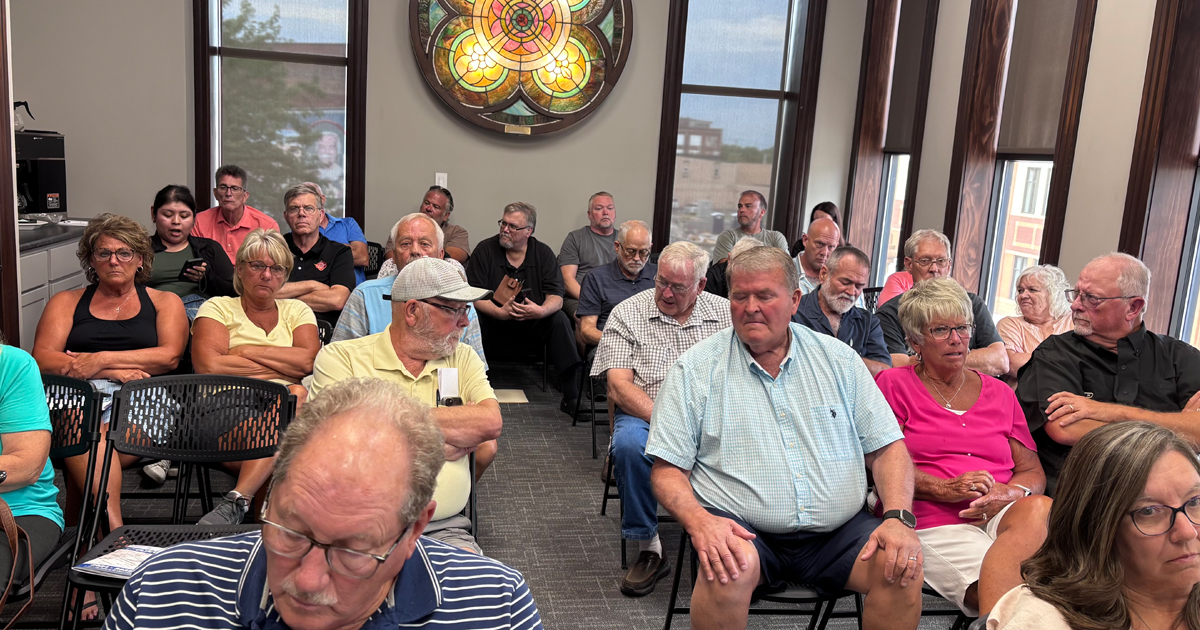
Members of the Frankfort and Clinton County community filled the second floor conference room of the Iron Block building tonight to hear from and ask questions of developers that are proposing a large-scale data center project spanning over 700 acres in Frankfort, with an estimated total investment exceeding $10 billion. (Photo: Brett W. Todd)

FRANKFORT, Ind. (July 15, 2025) — Members of the Frankfort and Clinton County community filled the second floor conference room of the Iron Block building tonight to hear from and ask questions of developers that are proposing a large-scale data center project spanning over 700 acres in Frankfort, with an estimated total investment exceeding $10 billion.

The project, spearheaded by Logistix, aims to bring significant economic benefits to Clinton County and the city of Frankfort, but it also raises questions and concerns among local residents regarding land acquisition, environmental impact, and job creation.

Doug Swain of Logistix stated that the development is envisioned as a transformational project for Frankfort. He highlighted that the companies they are in discussion with are “well capitalized institutional type of companies,” some of which would be recognizable names in the data center industry. These companies are very keen on community engagement and support.

The project’s location was chosen due to several factors, including its placement within an industrial park to promote “smart development” rather than sprawl, and its proximity to an existing substation. Frankfort’s location between Indianapolis and Chicago, its access to power and infrastructure, and a “nice underground aquifer” were also cited as advantages. Scott Wolf, another individual involved in the project, noted that Frankfort’s city-owned utility is a positive, and that the power company can provide 300 megawatts within a year, a significant factor as such capacity is not readily available.

Key Aspects and Community Concerns:

Land Acquisition and Homeowners

* The project grew from an initial 100 acres to over 700, prompting a need for more land. Developers initially prioritized larger farm owners due to planning timelines for initial filings.

* Homeowners within the proposed project area expressed concern about being overlooked and the potential undervaluation of their properties.

* Jim Shook, responsible for land acquisition, assured residents that he would begin reaching out to homeowners immediately to discuss purchasing their properties, emphasizing that the intent is to work toward a “fair agreement on valuations”. He clarified that the developers would offer to buy the land and that homeowners have the right to refuse, in which case the project would “build around” those properties as it is a private development and does not involve eminent domain. Properties explicitly identified for potential purchase include several homes in the center of the proposed area, south and east/west of County Road 50, near the railroad tracks.

* The developers intend to close land acquisition fairly quickly, allowing for flexibility regarding possession dates for homeowners.

Economic Impact and Jobs

* Developers project significant tax benefits for Clinton County from the substantial investment.

* Employment estimates were provided, ranging from 0.5 to 1 direct job per megawatt, plus an additional two indirect jobs. For a 600-megawatt facility, this could mean 300-600 direct jobs and potentially thousands of indirect jobs. These indirect jobs are expected to span years during the build-out phase.

* Concerns were raised about whether these jobs would be filled by local residents or outside contractors. Developers stated that data center operators prefer local employees for quick response to issues. They plan to engage with local tech colleges for training programs to support the industry, encouraging local talent development. The average annual salaries for employees at these facilities are projected to be close to $100,000.

Environmental and Utility Concerns

* Light Pollution: Developers pledged to design within ordinances and be sensitive to lighting needs, noting that data centers, unlike industrial facilities with heavy truck traffic, require less intense lighting, mainly for security which can be done with infrared. This was a particular concern given the proximity of the Prairie Grass Observatory.

* Noise Pollution: Residents expressed fears of noise likened to a “swarm of locusts”. Developers countered that modern data centers are “much more acoustically sound” and purposefully built, unlike older Bitcoin mining operations. They indicated that noise levels would be lower than those from typical manufacturing facilities and that sound walls could be implemented.

* Water Usage: The project’s potential demand for water from Frankfort’s aquifers was a key concern. Developers stated that the data center industry has made significant strides in sustainability, with some companies using “hardly any water” through air-cooling or sustainable practices, and even those using “a million gallons a day” doing so sustainably. They asserted that the project would not strain the city’s water supply, which recently underwent line upgrades, and that potential users themselves would not want to operate in an environment with strained resources.

* Electricity: The immense electricity needs (potentially 500-600 megawatts) were discussed. The plan involves building a new substation south of the tracks, fed by an existing substation with a 230-megawatt surplus, which would also benefit future manufacturing growth in Frankfort. Developers emphasized that the electrical service for the data center would be a “completely separate service” with an “independent separate power service agreement,” meaning its costs would be absorbed by the user and not burden the existing community utility system. Data centers also build redundancy into their power systems.

Tax Abatements and Community Impact

* A significant state incentive for data center operators is a sales tax exemption on electric and personal property, potentially saving hundreds of millions of dollars.

* Residents voiced concerns about the possibility of increased property taxes for homeowners to compensate for abatements offered to the data center, citing negative experiences in other counties like Boone County with the Lilly project. Developers believe the overall benefits from the company’s taxes and the influx of higher-earning residents would benefit the community and help maintain affordable prices.

Project Timeline and Future

* The overall project development is expected to span approximately 5 to 7 years, with phase one (already zoned industrial near Conagra) potentially taking 3 to 5 years.

* The technology within data centers is refreshed every five to six years, and the substantial investment involved means these facilities are designed for long-term commitment, not temporary operation. Developers are currently in discussions with a handful of “major players” to be the ultimate operator, with a potential deal being finalized in as little as “two months”. These companies are currently all U.S.-based.

The next step in the project is a July 23 public meeting before the City Plan Commission.

Clinton County EMS: Significant Shifts Proposed in Patient Transport Protocols

An undated photo of a Clinton County EMS ambulance parked outside the Clinton County Courthouse. At the Tuesday, July 8, 2025, Clinton County Council meeting Stephan Deckard, director of EMS, shared with council members proposed changes in transport protocols. (Photo by Brett W. Todd)

CLINTON COUNTY, Ind. (July 9, 2025) – Clinton County Emergency Medical Services (EMS) is embarking on significant shifts in its patient transport protocols and considering a change in its sponsoring hospital, driven by a commitment to evidence-based medicine and a focus on delivering higher levels of care to the community. EMS Director Stephen Deckard presented these upcoming changes during the Tuesday council meeting held in the Clinton County Courthouse.

Deckard reported that Clinton County EMS anticipates an approximate 7% increase in its annual run volume for the current year. He also noted a continuing trend of more patients being transferred out of Clinton County to facilities in Lafayette or Indianapolis.

A major change on the horizon involves the EMS agency’s sponsoring hospital. Deckard stated that due to a “continued lack of support” from IU Health, their current sponsoring hospital, Clinton County EMS is in “active discussions with Ascension” to take on that role. He explained that while IU Health Arnett, a level 3 trauma center, had a “heavy hand,” Ascension, a level 1 trauma center, is offering a “more friendly package” and is “much more willing to collaborate as a partner, a true partner”. Deckard noted a level 1 trauma center is better and also cited a “70% increase in pharmaceuticals” and other burdens as factors in this potential shift. He added that IU Health is “bleeding EMS partners throughout this region,” indicating that Clinton County is not alone in its reconsideration of the partnership.

These discussions are directly impacting patient transport destinations, particularly for critical cases:

Stroke Patients: In the “very near future,” more stroke patients will likely be transported to St. Vincent at 86th Street. Deckard emphasized that St. Vincent is a “comprehensive stroke center” with the unique capacity to perform mechanical thrombectomy – a procedure to remove blood clots from the brain vessel – which is not available locally. He noted that IU Methodist is a “further transport”. Deckard stressed that this decision is based solely on “evidence-based medicine” and “what is best for the community,” not on pushing an agenda related to partnerships.

STEMI Patients (Heart Attack): All STEMI patients, referring to an ST elevated myocardial infarction or what laypeople call a heart attack, will now be transported to St. Vincent at 86th Street or the Heart Center. Deckard explained that these are the closest Cath labs. He highlighted a significant issue with IU Arnett, stating they “will not activate a field STEMI” until the patient arrives at their facility. This delay, due to on-call cardiologists, can prolong care by an hour.

Deckard acknowledged that the transport time to St. Vincent at 86th Street is “45 minutes,” which is “15 minutes longer” than to Lafayette. However, he asserted that it provides a “more comprehensive center” with a “higher level of care” and “more resources”. Deckard reiterated his commitment to operating solely on “evidence-based medicine” and facilitating “better care for our community,” vowing not to be “pushed or inspired by other partnerships that facilitate their benefit and not our community benefit”.

On staffing, Deckard mentioned that EMS has “open positions” for paramedics. They currently have four individuals in training, three from their program and one from another, who are expected to graduate in December of this year and come online then.

Valley Oaks Health: A ‘New Era’ for Mental Health Services in Clinton County

Dan Arens, CEO of Valley Oaks Health, presents to members of the Clinton County Council at its Tuesday, July 8, 2025, meeting. Valley Oaks Health is the newly assigned community mental health center provider. (Photo by Brett W. Todd)

CLINTON COUNTY, Ind. (July 9, 2025) – Valley Oaks Health, newly assigned as Clinton County’s community mental health center, is set to significantly enhance local mental health services, particularly through its 24/7 mobile crisis intervention team. Dan Arens, CEO of Valley Oaks, presented the organization’s capabilities and plans to the Clinton County Council at its Tuesday meeting, emphasizing a shift towards community-based, accessible care.

Valley Oaks officially began its role in Clinton County on July 1st, having been assigned by the state of Indiana Department of Mental Health and Addictions (DMHA). Council member Carol Price highlighted the state’s new DMHA director, Sarah Sailors, for making a “huge difference” in bringing these services to Clinton County and other previously underserved areas.

Arens described Valley Oaks as a community mental health center that is not part of a large healthcare system, serving approximately 11,000 to 12,000 people annually across what will now be ten primary counties. With about 450 employees, Valley Oaks prides itself on being a local partner and highly accessible.

A core aspect of their approach is providing services directly in the community, including in schools, homes, jails, and even “under bridges,” aiming to ensure people can “come out of wherever they need to be and have access to care”. This access isn’t limited to therapy; they have staff trained for de-escalation and plan to have psychiatrists and psychiatric nurse practitioners providing care in Clinton County. Valley Oaks also offers open access to care to stabilize individuals and then integrate them into other necessary services. The organization is actively seeking both temporary and long-term space within the county and plans to introduce primary care services over time.

A key focus of Arens’ presentation was the mobile crisis team, designed to provide immediate, on-site support:

24/7 Availability: These crisis services are available around the clock, with a mobile team already responding to individuals in Clinton County.

Peer-Led Model: The team includes peers – individuals with lived experience in addictions and/or mental health who have recovered and are trained for intervention.

Team Composition: Comprised of peers, mental health technicians, and EMTs.

Response Protocol: They respond directly to people’s homes or hospitals, aiming to “take the person under our wing” to ensure they reach the appropriate destination, thereby alleviating the burden on law enforcement officers.

Medical Coordination: If medical clearance is required at an emergency room, the team coordinates that process.

Suicidal Individuals: For individuals who are suicidal, the team ensures they are placed into the “correct inpatient bed”.

Jail Diversion: A significant intent of these crisis interventions is jail diversion, offering an alternative for individuals struggling with or under the influence of drugs who do not require arrest. The service transforms a “potential criminal situation into a mental health situation”.

Contact: Individuals can reach the crisis services by calling 866-6-VALLEY and selecting the crisis option.

The council acknowledged that Valley Oaks staff had previously explained these emergency services at a community meeting on June 20th, where attendees “really drilled them” with questions, and “nobody held back”. Arens expressed appreciation for the confidence placed in Valley Oaks by the community. He is also expected to attend the next commissioners’ meeting and provided informational flyers to the council.

The county welcomes Valley Oaks, recognizing it as the beginning of a “new era” for mental health services.

Kellys, AG Rokita Legal Battle Heads to Tipton County Tuesday

A legal battle is unfolding in Clinton County, as the State of Indiana, led by Attorney General Todd Rokita, seeks to recover over $329,000 (plus treble damages pursuant to Indiana's Crime Victims Relief Act) from Clinton County Sheriff Richard Kelly, his wife Ashley Kelly, and their limited liability company, Leonne, LLC. The parties of this case will meet in Tipton County Circuit Court on Tuesday, July 8, 2025 at 2pm. (Photo by Derek Jensen/Wikipedia)

FRANKFORT, Ind. (July 6, 2025) – A legal battle is unfolding in Clinton County, as the State of Indiana, led by Attorney General Todd Rokita, seeks to recover over $329,000 (plus treble damages pursuant to Indiana’s Crime Victims Relief Act) from Clinton County Sheriff Richard Kelly, his wife Ashley Kelly, and their limited liability company, Leonne, LLC.

The State alleges misappropriation of public funds, malfeasance, misfeasance, and nonfeasance related to Ashley Kelly’s roles as Jail Matron and Commissary Manager, while the Kellys vehemently deny wrongdoing, asserting their actions were lawful and based on professional advice.

Due to the nature of this case a special judge from Tipton County has been named to oversee the case, Thomas R. Lett.

The parties of this case will meet in Tipton County Circuit Court on Tuesday, July 8 at 2pm.

A brief overview of the claims alleged by the Attorney General Rokita and the Kellys’ defenses.

The State’s Allegations: Misappropriation and Policy Violations

The lawsuit, filed in Clinton Circuit Court, stems from a Special Investigation Report by the State Board of Accounts (SBOA) covering January 1, 2019, to September 30, 2021. The SBOA report, cited as Exhibit 1 in the State’s complaint, alleges that public funds were “misappropriated, diverted, or unaccounted for,” “illegally received,” “illegally retained,” “obtained by fraud or in any unlawful manner,” and/or “wrongfully withheld from the public treasury”.

Key allegations from the State include:

* Nepotism Violations: Richard Kelly, as Sheriff, hired his spouse, Ashley Kelly, as both jail matron and commissary manager, which the State claims violated Clinton County’s anti-nepotism policy. The State also asserts the Kellys failed to properly disclose their ownership interest in Leonne, LLC, and their marital status on conflict disclosure forms.

* Improper Disbursements: The SBOA found that checks totaling $190,916.61 were improperly issued from the Jail Commissary Fund to Leonne, LLC, and $32,967.92 to Ashley Kelly, between January 1, 2019, and September 30, 2021, without written agreements to support or authorize these payments. These payments were calculated as 50% of commissary profit on merchandise sales.

* Dual Compensation and Undocumented Hours: Ashley Kelly received a salary as jail matron from the County General Fund and additional compensation as commissary manager from commissary profits. The State alleges her hours for these positions were not documented and that she may have been receiving disability pay from the Indiana State Police (ISP) concurrently.

* Pecuniary Loss and Audit Costs: The State claims Clinton County suffered a pecuniary loss of $219,634.65 due to these alleged breaches of duty, and the SBOA incurred $109,725.82 in additional audit costs, for a combined total of $329,360.47. The State is seeking this total amount, disgorgement of “ill-gotten gains,” and enhanced damages, including treble damages under Indiana’s Crime Victims Relief Act, which applies to losses resulting from certain criminal codes like conversion or theft.

* Surety Liability: Western Surety Company and RLI Insurance Company, as sureties for Richard and Ashley Kelly respectively, are also named as defendants, with potential liabilities of $90,000 and $15,000.

The Attorney General’s office argues that for Count I of the complaint (malfeasance, misfeasance, and nonfeasance), proof of criminal intent is not required for the State to recover funds. Citing the Indiana Court of Appeals case Montalvo v. State ex rel. Zoeller, the State contends that its authority to recover misappropriated or diverted public funds is “irrespective of whether the person who wrongfully received public money knew that he or she was not lawfully entitled to receive it”.

They define misfeasance as performing a lawful act in an unlawful manner, and nonfeasance as an omission to perform a required act, neither of which necessarily requires intent. The State notes that prior legal rulings have already established as undisputed facts that the Kellys created Leonne LLC to receive profits and that their agreements were not submitted to the County for approval.

The Kellys’ Defense: Good Faith, Reliance on Advice, and Alleged Retaliation

Richard and Ashley Kelly, represented by counsel Theodore J. Minch, contest the State’s claims, arguing they acted in good faith and that the lawsuit is part of a pattern of “selective enforcement, retaliatory actions, and unequal treatment”.

Their defense rests on several points:

* Reliance on Legal and Professional Advice:

Sheriff Richard Kelly states he sought legal counsel from Clinton County Attorney Thomas Little both prior to and after taking office regarding Ashley’s appointment and his own compensation. Attorney Little allegedly advised that appointing his wife as Jail Matron and Commissary Manager was lawful under Indiana statute and consistent with historical practice, referencing three prior sheriffs whose wives held similar roles and shared a 50/50 split of commissary profits with the County.

Little reportedly “affirmatively agreed to ‘set up’ and ‘take care of’ the arrangement,” including filing conflict-of-interest and nepotism forms. Richard Kelly later learned Little had drafted these documents but “neglected” to provide them.

Ashley Kelly consulted Nancy Ward and Wanda Mitchell, wives of former sheriffs, who confirmed the duties and the practice of receiving additional money from commissary operations. Nancy Ward reportedly informed Ashley that commissary monies would be “sizeable” and she would receive a 1099 from the County.

The Kellys’ CPA and financial advisor, Dennis Hayden, advised them to form Leonne, LLC, as a two-member LLC (Ashley 51%, Richard 49%) to minimize personal liability and optimize tax consequences for the 1099 income. They assert Leonne, LLC, actually enhanced transparency compared to prior methods.

* Beneficial Commissary Management: Ashley Kelly insists that only she performed the work of Commissary Manager, and the money earned was not funded by tax dollars, but rather from net proceeds of commissary sales, identical to her three predecessors. She claims to have significantly increased revenue “by tens of thousands of dollars” by adding products and securing a lucrative agreement with the U.S. Marshals Service to house federal detainees. These increased profits allowed the Sheriff’s Office to purchase essential equipment, such as a body scanner, K9 unit, snowplow, and other items, “without using taxpayer money”. She also obtained a Tobacco Sales Certificate to legally sell e-cigarettes, further boosting sales.

* Transparency and Compliance: Ashley Kelly states she provided semi-annual commissary fund reports to the Clinton County Council as required by law since 2019, and monthly bank statements were sent to the SBOA by the Records Clerk. She notes that the County Council President even praised her “numbers” and told her to “keep doing what you’re doing” after a report.

* Allegations of Animosity and Retaliation: The Kellys contend that Clinton County officials, including Commissioners and Attorney Thomas Little, have consistently opposed and undermined them since Sheriff Kelly’s election. Richard Kelly believes this animosity is partly due to his Filipino ethnicity. They assert that hostilities began when Sheriff Kelly questioned his proposed salary, which was below the statutory minimum for Clinton County’s size.

Ashley Kelly alleges that County Council President Alan Dunn “recreated a commissary report” and Prosecutor Anthony Sommer “falsely represented this fabricated report to journalist Brett Todd as the official report,” which contained “numerous accounting and mathematical errors”. They view the SBOA audit as a “sham and witch hunt” timed for the 2022 Sheriff election, noting that a nepotism violation alleged in the SBOA report was later “adjudicated in Tippecanoe County where we were found to NOT be in violation”. They also state that despite the Commissioners’ public awareness of her role and compensation, they failed to provide her a formal contract, and she has not been paid for commissary work since September 15, 2021, though she continues to perform the duties.

* Legal Interpretation of Intent: The Kellys’ counsel argues that malfeasance, misfeasance, and nonfeasance, particularly when related to criminal charges or penalties, require proof of “intentional acts” or a “conscious objective” to cause a loss. They contend that their good-faith reliance on the advice of a licensed attorney and CPA negates any unlawful intent, and a “mistake of fact” defense is applicable if they honestly believed their actions were lawful due to the information they received. They emphasize that the State has not proven they intentionally caused a loss, and the Kellys’ actions actually increased County funds. They also argue that treble damages, being punitive, require “willful or knowing misconduct,” which they say is absent given their good faith actions and reliance on counsel.

Ongoing Legal Dispute

The case was originally filed on March 30, 2023, with the State requesting summary judgement on September 16, 2024, arguing that the material facts for Count I are undisputed and the legal issues were already determined in its favor by the Court of Appeals. The State has also filed a motion to strike the Kellys’ affidavits and exhibits, citing improper designation, lack of authentication, and untimeliness. The Kellys maintain that genuine issues of material fact preclude summary judgment and that their intent, or lack thereof, is central to the claims.

Criminal charges are also pending against Richard and Ashley Kelly in a correlated case. In the criminal case, the State has dropped the charge of Conflict of Interest leaving three charges of Official Misconduct, though these cases remain “undecided” with a trial date set for October 14.

The Kellys have filed lawsuits against County Attorney Thomas Little in Tippecanoe County and Clinton County Prosecutor Anthony Sommer in Boone County. Each of those cases remain “undecided.”

Frankfort Protest Escalates, Leads to Arrests and Charges

FRANKFORT, Ind. (June 20, 2025) – An ongoing one-person protest in front of Frankfort’s city building escalated into a physical altercation on Thursday evening, June 19, leading to the arrests and subsequent charges for two individuals.

The Frankfort Police Department and Clinton County Sheriff’s Office responded to reports of a fight at 301 E Clinton Street, also known as Old Stoney, which had been the site of a small, one-person protest since 4 p.m.. Earlier that evening, at 7:01 p.m., authorities had responded to the location for the protester’s usage of fireworks, issuing a warning after the individual stated they would not do it again. Shortly thereafter, at 7:23 p.m., Clinton County Central Dispatch began receiving reports that the protester was yelling at people driving by on Walnut Street. A shift change of corrections officers and dispatchers at the jail also reported fireworks.

At approximately 7:38 p.m., an officer observed 28-year-old Tyler Niccum of Frankfort throw objects at the protester, 26-year-old Cody Bishop of Indianapolis. Niccum then sat down at a picnic table on the property. Bishop subsequently walked to Niccum, and a fight or struggle occurred over a sign Bishop was holding. During this confrontation, Bishop pointed a firearm at Niccum, who then retreated. Officers intervened and separated both parties while conducting an investigation.

Investigators learned that prior to the observed altercation, Niccum had approached Bishop to examine Bishop’s sign, which reportedly had Niccum’s name on it. While Bishop was at his truck, he walked towards Niccum in close proximity and pushed the sign towards him. Niccum responded by swatting the sign away, at which point Bishop hit Niccum with the sign. Niccum then went back to his car, which was parked on the west side of Prairie Creek, and called the police. However, Niccum did not wait for law enforcement and re-engaged with Bishop.

Both Niccum and Bishop were arrested following the incident. Bishop resisted arrest, causing minor injuries to two Frankfort Police Officers, though no medical attention was necessary.

Charges were filed by the Clinton County Prosecutor on June 20, 2025:

• Tyler Niccum faces one count of Disorderly Conduct: engaging in fighting or tumultuous conduct (35-45-1-3(a)(1)/MB).

• Cody Bishop faces multiple charges, including:
◦ Two counts of Resisting Law Enforcement: Defendant causes bodily injury (35-44.1-3-1(a)(1)/F6).
◦ Unlawful Use of Body Armor: defendant uses body armor while committing a felony (35-47-5-13(b)/F6).
◦Disorderly Conduct: engaging in fighting or tumultuous conduct (35-45-1-3(a)(1)/MB).

Frankfort Police Chief Scott Shoemaker commented on the incident, stating, “Individuals who want to exercise their first and second amendments are freely able to do so in our society”. However, he emphasized, “What they will not do is incite violence and disrupt normal day-to-day activities for our city residents and visitors”. The Frankfort Police Department strongly encourages citizens to not engage with protestors.

Clinton County Names Interim EMA Director, Public Safety Veteran Renee Crick Tapped for New Role

Clinton County Commissioners announced at its June 17, 2025, meeting that Clinton County Dispatch Director Renee Crick will serve as Interim Director of Clinton County Dispatch. Crick will continue her role as director of Clinton County Dispatch.

FRANKFORT, Ind. (June 17, 2025) – The Clinton County Commissioners have named Renee Crick, Director of Clinton County 911 Central Dispatch, interim director of the Clinton County Emergency Management Agency (EMA), following the retirement of longtime EMA Director Darrell Sanders.

Crick brings more than 35 years of public safety experience to the role, including 15 years at the helm of Central Dispatch, where she led the consolidation of Frankfort Police, Fire, and the Clinton County Sheriff’s Office into a unified emergency communications center in 2010. A former dispatcher for Frankfort Police and volunteer EMT with Mulberry Ambulance, Crick has also served on the county’s Local Emergency Planning Committee (LEPC) for the past 15 years.

“Renee was the obvious choice,” says Jordan Brewer, president of the Clinton County Commissioners. “She’s a proven leader who understands how to bring agencies together and has a deep, personal investment in the safety of our residents. Her background in dispatch and long-standing relationships throughout the public safety community make her an ideal fit during this transitional period.”

As interim EMA director, Crick will focus on strengthening relationships between emergency management and public safety partners across the county, as well as engaging both public and private sectors in emergency preparedness efforts. She will continue serving as Director of Central Dispatch—a role she remains deeply passionate about.

“My heart is still in dispatch, and I’m not stepping away from that, but I’m up for this new challenge” Crick says. “I’m coming into this with an open mind and a willingness to listen and learn. I love Clinton County and welcome the opportunity to further serve its residents.”

The interim appointment gives county leaders time to assess the future of the EMA office and determine the best long-term path forward.

Commissioners Declares today as Clinton Prairie Boys Basketball Team Day In Clinton County

Clinton County Commissioners declare June 17, 2025, as Clinton Prairie Boys Basketball Team Day. Pictured left to right are commissioner Kevin Myers, commissioner Jordan Brewer, CP Boys Basketball Head Coach Chad Peckinpaugh, and commissioner Bert Weaver.

FRANKFORT, Ind. (June 17, 2025) – The Clinton County Commissioners have declared today as Clinton Prairie Boys Basketball Team Day.

The recognition was based on the achievement of the team during the 2024-2025 season which resulted in being the 1A State Runners Up.

Along the way to State the team accomplished a number of other titles: Hoosier Heartland Conference Championship, Sectional Championship, Regional Championship, and Semi-State Championship.

The team consisted of Head Coach Chad Peckinpaugh, Assistant Coach Ruas Doyle, Assistant Coach Bailey Good, and Assistant Coach Dirk Shaw, Managers Bella White, Adalen Reeder and Dejah Johnson, along with the players, Alex Farley, Ryan Harshbarger, Jake McGraw, Jake Swinford, Kyle Harshbarger, Evan Smock, Nick Curtin, Hunter Haynes, Nick Ewing, Rhett Whitlock, Jaymon Crick, Conner Haynes, Gaige Kuzmicz, Brady Allen, and Conner Rios.

Allegations of Editing State Board of Accounts Audit Report, New Trial Date Set

LEBANON, Ind. (April 23, 2025) – Attorneys for Clinton County Sheriff Richard Kelly and Jail Matron Ashley Kelly were in a Boone County courtroom to provide a status update on the large document drop just days prior to the start of the April 8 trial which resulted in the trial being delayed.

In the April 14 hearing, in answering questions from Boone County Judge Lori Schein, attorney for Mrs. Kelly, Mario Massillamany, shared that Clinton County Prosecutor Anthony Sommer and Clinton County attorney Tom Little were sending emails to the Attorney General office asking for the AG to join the civil case.

Attorney for Sheriff Kelly, Theodore Minch, added that in addition to those emails, new documents show they were actively editing the State Board of Accounts audit report on the Kellys and passing it back-and-forth.

A hearing on sanctions was not set – allowing the attorneys for Little and the Kellys to receive the promised privilege log of the newly received documents and to review the contents.

In an additional matter, Massillamany filed a motion to dismiss count #3 – criminal conversion – against Mrs. Kelly.

Criminal conversion is the act of knowingly or intentionally exerting unauthorized control over someone else’s property.

Massillamany’s argument was based on two documents he entered as exhibits A & B showing that Mrs. Kelly had authorized authority over the commissary funds.

Exhibit A was a 2021 written contract from an oral agreement between Sheriff Kelly and Mrs. Kelly to be the commissary manager at the same pay and duties as previous commissary managers.

Exhibit B was a written contract between Sheriff Jeff Ward and Nancy Ward, his wife, to perform the duties of commissary manager.

Massillamany noted the two agreements were identical but for paragraph 5 of Mrs. Kelly’s contract that made it retroactive to January 1, 2019.

Judge Schein asked special prosecutor Stanley Levco if Mrs. Kelly had a contract in place at the time she was put in place as commissary manager would he have filed conversion charges.

Levco was not the special prosecutor when charges were filed. Levco was appointed to the case in October 2024 after the previous special prosecutor – David Thomas – was elected judge in his home county.

Levco replied, had she had a contract at the time charges were filed – “maybe not. But she didn’t.”

The State filed its charges in 2022.

According to online case entries, the State filed a brief in response to defendant’s motion to drop count #3 on April 16.

Judge Schein took the matter under advisement.

A new trial date was set during the hearing.

Judge Schein informed the parties that the Clinton County courthouse will begin renovations soon and asked if there were objections to selecting a Clinton County jury and having the case in Boone County.

There were no objections and Tuesday, October 14 was selected after conferring with both sides on scheduling conflicts.

State Dismisses Count #4 in the Kellys Case, Judge Grants Continuance

State Dismisses Count #4 in the Kellys Case, Judge Grants Continuance
State Dismisses Count #4 in the Kellys Case, Judge Grants Continuance during a pretrial hearing Monday, April 7, 2025, at the Clinton County courthouse.

FRANKFORT, Ind. (April 7, 2025) – The Special Prosecutors handling the case against Sheriff Richard Kelly and his wife Ashley have dismissed count #4 – “signed under penalties of perjury statements related to their relationship with each other, in violation of the criminal offense of Perjury” – today during a pretrial hearing in the Clinton County courthouse.

The Kellys also filed with the Court to have the case continued after a large document drop – including audio files – were made available to them late last week.

The documents and audios were part of a discovery request that was two years old. And comes after assurances were made to Special Judge Lori Schein – during an in-chamber review, including attorneys representing County Attorney Tom Little – that all documents had been turned over during the August 2024 gathering.

This new data drop is described as a collection of 3,000 documents comprising some 10,000 pages plus audio files. Many of the documents contain redacted sections and a promised privilege log has yet to be turned over to the defense.

Judge Schein stated she was not pleased with granting the continuance noting the amount of time that has been spent to have the trial start this week. Judge Schein noted that balancing an ineffective council argument along with charges that are felonies that carry jail time outweigh continuing the case this week.

Attorney for Ashley Kelly – Mario Massillamany – asked the court to conduct a hearing on sanctions against attorney Tom Little, the Law Firm of Power, Little, Little, Little, and the attorneys that represent Tom Little as to why the delay in complying with the court’s order. Massillamany requested attorney’s fees paid by the Kellys among other items be considered as a remedy.

Judge Schein has set April 14 as a pretrial hearing to determine next steps as well setting a hearing on sanctions.

An additional item that will be discussed on April 14 is the defense motion to drop count #3 – “engaged in a violation of the Criminal Conversion statute (IC 35-43-4-3 (a) by Richard L. Kelly receiving commissary funds through his ownership in Leonne LLC.”

State, Kellys Trial to Start

Kellys criminal trail to being
The three-year-old criminal case involving Clinton County Sheriff Richard Kelly and his wife, Ashley, is set to begin on Tuesday, April 8, 2025, with selecting six jurors and three alternates. They are each facing four level 6 Felonies.

FRANKFORT, Ind. (April 6, 2025) – The three-year-old criminal case involving Sheriff Richard Kelly and his wife, Ashley, is set to begin on Tuesday with selecting six jurors and three alternates.

But first the State and the Kellys will face off in a hearing Monday morning to hear the State’s motion to limit the introduction of evidence in the case according to online court entries.

This is in response to the Kellys having notified the State of their intention to use an affirmative defense – mistake of fact – to the four charges. An affirmative defense places the burden of proof on the defense.

The Kellys each face one count each of the following (all are Felony 6):

1. as public servants knowingly or intentionally had a pecuniary interest in or derived a profit from a contract connected with their governmental entity served by the public servant;

2. engaged in a violation of the criminal Conflict of Interest statute;

3. engaged in a violation of the Criminal Conversion statute (IC 35-43-4-3 (a) by Richard L. Kelly receiving commissary funds through his ownership in Leonne LLC; and

4. signed under penalties of perjury statements related to their relationship with each other, in violation of the criminal offense of Perjury.

Although the court documents are not available, Clinton County Today was in the courtroom for the final pretrial hearing on March 12th when attorneys Theodore Minch and Mario Massillamany representing Sheriff Kelly and Ashley, respectively, were going back and forth with Special Judge Lori Schein.

The defense attorneys were asking for evidence to be allowed that the Kellys relied on attorney Little to perform the required work.

Attorney Massillamany to Judge Schein: “We filed a notice of affirmative defense – mistake of facts. And I think that would go into the arguments of affirmative defense – mistake of fact.”

Judge Schein: “Meaning what?”

Attorney Massillamany: “They relied on Mr. Little to fill-out the conflict waiver on their behalf.”

Later in the hearing, Judge Schein said to attorney Minch: “I’ve seen the emails. It looked like there was a conflict of interest form sent by Mr. Little on behalf of your clients before he took office.”

At the Monday hearing, the Kellys could argue that other county officials have not uploaded conflict of interest forms to the State Board of Accounts website.

Here are examples of missing conflict forms:

County Council President Alan Dunn was awarded a cash rent farming contract to farm the county farm in 2021. Dunn paid the county $325 per acre each for four years. He was able to collect any amounts above the $325 minus expenses. The 136-acres is located behind Parkview Home and the conflict form was presented at a commissioners meeting on February 1, 2021 – yet was never uploaded to the SBOA.

Not until June 26, 2024, was the conflict form uploaded to the SBOA disclosing his monetary interest from the contract.

Commissioners President Jordan Brewer presented not one, but two conflict forms acknowledging his father, Kent Brewer, is sole owner of KB Ditching and as a member of the Clinton County Drainage Board his father had been contracted previously prior to becoming a commissioner and could be selected to do work in the future through a competitive bid process.

The first was during a Commissioners meeting on February 17, 2021, where he stated, “Tom felt it best if we at least had a conflict of interest statement that we filed with the state.” County Attorney Tom Little was not at the meeting.

The second was during a Drainage Board meeting on March 1, 2021, where county attorney Tom Little was present. Attorney Little stated, “Just to be safe we will have it done twice. Once within the Board of Commissioners and again with the Drainage Board.”

Neither of those two forms were uploaded to the SBOA. A “full disclosure statement, contract disclosure requirement” for Commissioner Brewer was uploaded to the SBOA website on October 11, 2024.

With both the Dunn and Brewer conflict forms, it is unknown at this time who is responsible for uploading the document to the SBOA.

Go to Top