Category archive

Clinton County - page 2

Frankfort BOW Approves Measures: K9 Athena Retirement, Halloween Hours, and Unsafe Property Action

The Frankfort Board of Works (BOW) approved a range of measures, including setting annual trick-or-treat hours, greenlighting legal action against an unsafe property, and securing a $4,600 refund, during its recent meeting Monday evening.

FRANKFORT, Ind. (September 22, 2025) – The Frankfort Board of Works (BOW) approved a range of measures, including setting annual trick-or-treat hours, greenlighting legal action against an unsafe property, and securing a $4,600 refund, during its recent meeting Monday evening.

Halloween trick-or-treat hours for October 31, 2025, will take place between 5:00 p.m. to 9:00 p.m..

Police Chief Scott Shoemaker asked for board approved for the customary transfer of ownership for retiring K9 Athena to her handler, Lieutenant Chris Salaba. K9 Athena, who was purchased from a police department in Virginia, has served for about eight years, with the last five years spent alongside Lt. Salaba. The ownership transfer agreement between the Frankfort Police Department and Lt. Salaba will be effective October 7, 2025, at 5:00 p.m., coinciding with a planned retirement party.

In city infrastructure and legal matters, the board took action on two key issues.

The city secured approval to proceed with filing documentation in circuit court concerning a long-standing issue with an unsafe property. The action authorizes the city to seek court approval to take the house down if the property owner does not comply. The documentation, prepared by the city attorney Alicia Albertson and supported by engineering inspections, proves the house is unsafe and needs to be torn down. If the city takes the property down, it will file a lien on the property.

Following an issue with splash pad winterization, the board approved a release of claim with the insurance company representing the winterization company, allowing the city to recover $4,600. The funds will be returned to the city’s general fund. Approval of the release constitutes a final and full settlement, precluding the city from requesting additional funds for that particular winterization issue.

The board also approved Resolution 25-08, which adopts an updated Title VI implementation plan for the city. This resolution is essential to maintain the city’s eligibility for continued federal funding.

The Parks Department received approval to proceed with the rehoming of several animals on its list; three donkeys, three large birds, several smaller birds along with foxes.

Additionally, the board approved a proposal to add nine new parallel parking stalls on Clinton Street. These stalls will be placed in front of the IvyTech building, the music store, and a couple on the bridge, adding capacity where previous areas were designated yellow (no parking). Officials confirmed the plan does not interfere with existing ADA-compliant parking spaces.

In minor administrative action, the board granted a $20 permit fee waiver for St. Mary’s Catholic Church for a fence permit.

The board received updates from various departments.

The Fire Department’s tanker vehicle is back in service. Engine 3 is expected to be delivered in January. Fire officials noted concern that the last two existing trucks are “literally on their last leg” and will require future discussion on replacement options.

City officials discussed the disposal of old electric vehicle (EV) chargers that were recently replaced. The chargers were valued by the company that sold the new units at $200 to $300. Since they fall under the $1,000 threshold, the city has several options, including private sale, auction, or deeming them valueless and disposing of them. Staff will reach out to previously interested parties to gauge serious intent to purchase the chargers before proceeding.

Officials noted that the current concession stands contract is expected to expire around the end of October. Staff plans to bring a proposal regarding the renewal or adjustment of the contract for events, potentially including the soup kitchen, at the next meeting.

Progress was noted on the County Annex Building regarding ADA compliance, with sidewalk cutting underway. Paving for Washington Street is tentatively scheduled to begin the following week, provided curb and gutter work is completed.

Clinton County Sheriff Richard Kelly, Wife Ashley Kelly to Pay Over $329K in Jail Commissary Case

A Tipton Court special judge has granted summary judgment against Clinton County Sheriff Richard Kelly, Ashley Kelly, and their company, Leonne, LLC, ordering them to pay a total of $329,360.47 for the improper issuance of funds from the Jail Commissary Fund.

CLINTON COUNTY, Ind. (September 22, 2025) — A Tipton Court special judge has granted summary judgment against Clinton County Sheriff Richard Kelly, Ashley Kelly, and their company, Leonne, LLC, ordering them to pay a total of $329,360.47 for the improper issuance of funds from the Jail Commissary Fund.

The court order, filed September 17, 2025, awarded the amount, which includes $219,634.65 in pecuniary damages and $109,725.82 in audit costs, to the Plaintiff, the State of Indiana. The judgment was granted jointly and severally against Richard Kelly, Ashley Kelly, and Leonne, LLC for Count I of the complaint, which related to misfeasance or nonfeasance.

The ruling follows a motion for summary judgment heard on August 21, 2025. The court found that there was no genuine issue of material fact regarding the claim.

Audit Findings Cited
The ruling relied heavily on findings set forth in the State Board of Accounts (SBOA) Special Investigation Report B57892, which examined the financial records of the Clinton County Sheriff’s Office and Jail Commissary for the period of January 1, 2019, to September 30, 2021. The SBOA, a state agency responsible for auditing public entities, concluded that funds totaling $219,634.65 were improperly issued and deposited from the Jail Commissary Fund to Ashley Kelly and Leonne LLC.

The couple created Leonne, LLC, in which Ashley Kelly held a 51% membership and Richard Kelly held a 49% membership, for the purpose of receiving profits from the sale of commissary items.

The court found that during the audit period, 85 checks totaling $190,916.61 were improperly issued from the Jail Commissary Fund to Leonne, LLC without a required written agreement to support or authorize the payments. Additionally, checks totaling $32,967.92 were issued directly from the fund to Ashley Kelly without required written authorization. These checks were calculated as 50 percent of commissary profits on merchandise sales.

The court noted that Richard Kelly and Ashley Kelly received their respective ownership shares of payments made to Leonne from the Jail Commissary Fund.

Binding Precedent Established
The Tipton Court found itself bound by related material facts and orders set forth in a separate Declaratory Judgment Action in Tippecanoe County Circuit Court (Cause 79001-2104-PL-000035) and the subsequent Indiana Court of Appeals Order (Case No. 22A-PL-2640).

The Indiana Court of Appeals affirmed the trial court’s finding that the County must approve contracts regarding the distribution of profits from the commissary fund. The Indiana Supreme Court denied a Petition to Transfer the case filed by Sheriff Richard Kelly and the County Sheriff’s Office on or about December 7, 2023.

Indiana Code § 36-8-10-21 provides for the Sheriff’s commissary fund, but dictates that for the Sheriff to disburse profits, there must also be County approval. The court found that at all relevant times, checks issued from the Jail commissary to Leonne, LLC lacked approval from the County fiscal body as required by Ind. Code § 36-8-10-21(d)(9).

The court concluded that intent was not material to granting summary judgment on Count I (misfeasance or nonfeasance). Citing prior Indiana case law, the court stated that if funds have been misappropriated or diverted, the State may seek and secure recovery of those funds “irrespective of whether the person who wrongfully received public money knew that he or she was not lawfully entitled to receive it.”

The Plaintiff orally withdrew its pursuit of summary judgment as to Count II for treble damages under the Crime Victim’s Relief Act (CVRA) for the purposes of this motion only, reserving all rights as to both Counts II and III and all other claims against the Defendants.

In response to the court’s order, the commissioners have demanded the immediate resignation of the sheriff and his wife.

The Kellys each face three Level 6 charges in criminal court relating to issues stemming from the operation of the jail commissary. The Boone County judge hearing the criminal case has set the trail to begin on May 11, 2026.

There are two additional legal cases pending involving the Kellys. The Kellys have filed suit against Clinton County Prosecutor Anthony Sommer in Boone County and a suit involving Clinton County Attorney Thomas Little in Tippecanoe County. Both cases remain pending at the time of this article according to online court documents.

Clinton Prairie Air Quality: CO2 Fixed, Mold Contained

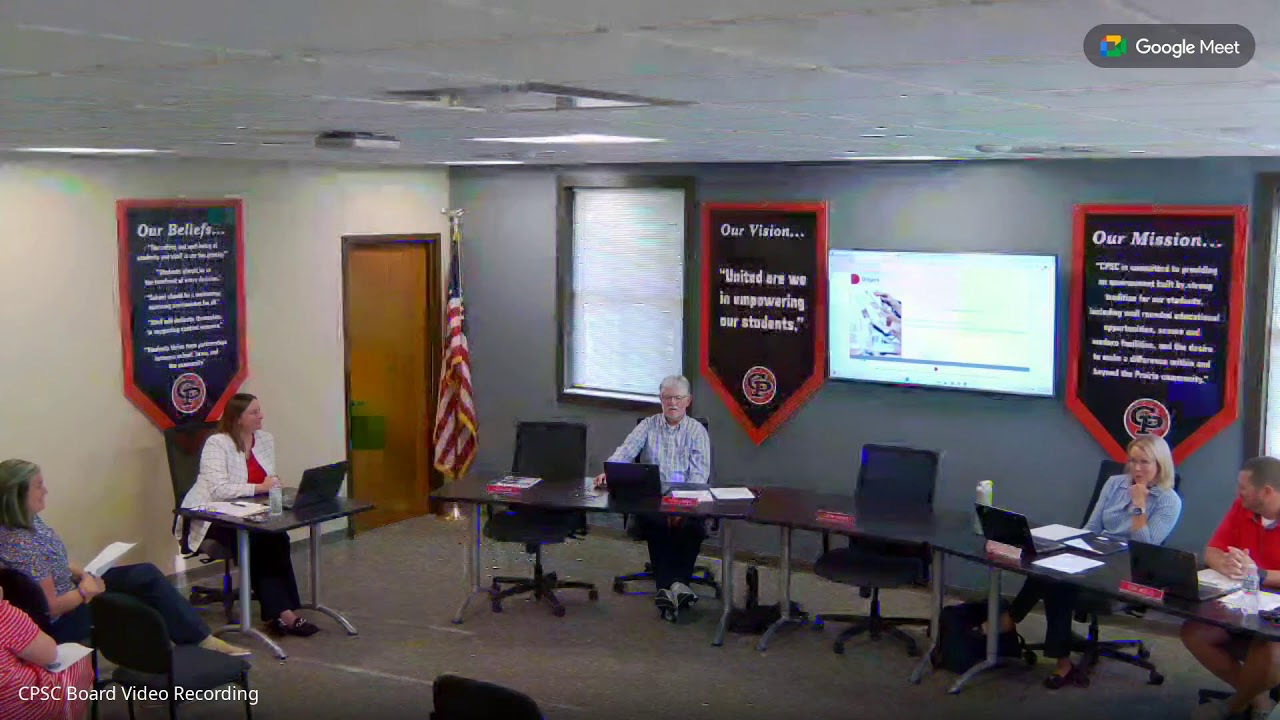
A state indoor air quality evaluation at Clinton Prairie revealed that carbon dioxide levels in one classroom exceeded state limits, prompting immediate corrective actions, while overall fungal (mold) concentrations within the school were found to be lower than outdoor levels. The findings of the report, dated September 4, 2025, were a central topic at the September 15, 2025, Clinton Prairie school board meeting, where issues of transparency and communication with parents were raised. (image/YouTube)

FRANKFORT, Ind. (September 16, 2025) — A state indoor air quality evaluation at Clinton Prairie revealed that carbon dioxide levels in one classroom exceeded state limits, prompting immediate corrective actions, while overall fungal (mold) concentrations within the school were found to be lower than outdoor levels.

The evaluation, conducted by the Indiana State Department of Health on August 26, 2025, was initiated following a request from a concerned citizen regarding health concerns potentially linked to indoor air quality at the school. The findings of the report, dated September 4, 2025, were a central topic at the Monday night Clinton Prairie school board meeting, where issues of transparency and communication with parents were raised.

CO2 Levels Exceed Limits in One Classroom
The highest carbon dioxide (CO2) reading recorded was 1401 parts per million (ppm) in classroom E-22 according to the report. This measurement exceeded the state’s allowable limit of 1100 ppm, which is defined as 700 ppm over the outdoor concentration. Melissa Hodson-Ostler, Administrator for the Clinton County Board of Health, explained that elevated carbon dioxide concentrations indicate too much occupant exhaust and a need for increased fresh air circulation.

Rick Plew, an Industrial Hygienist with the Indiana State Department of Health, recommended checking the damper in classroom E-22 to ensure an adequate supply of outside air. School officials confirmed that the faulty outdoor air damper actuator in the classroom has since been replaced and tested to ensure proper functionality and outside air supply. This issue was described as an “easy fix” and the only “actionable item” identified in the report.

Indoor Mold Lower Than Outdoors, Pre-School Remediation Detailed
Despite community concerns and social media rumors about mold, the evaluation found that fungal (mold) concentrations inside the school were consistently lower than the outdoor concentration. While there are no established acceptable limits for indoor fungal counts, guidelines generally recommend fewer counts indoors than outdoors. Hodson-Ostler noted that measurable mold is common, particularly in agricultural areas like Indiana, and can be tracked indoors.

Clinton Prairie School Corporation Superintendent Dr. Rebecca Boddicker and Hodson-Ostler clarified that initial issues, including a new chiller unit causing condensation and mold discovery in a new hallway, were addressed before students began the school year. Maintenance Director Kurtis Camp had adjusted new chiller unit settings, and affected moldy items were removed, and areas cleaned. Precautionary measures, taken in consultation with the Board of Health, included removing compromised tiles and insulation, and utilizing air scrubbers in the halls. Hodson-Ostler emphasized that these proactive steps meant “nothing occurred because of it” once school started. The school’s design, where individual rooms ventilate to the outside rather than to adjacent rooms, further helps prevent the spread of air quality issues throughout the building.

Humidity Levels Within State Guidelines
Indoor relative humidity during the evaluation ranged from 53% to 58%, while the outdoor relative humidity was measured at 44%. State regulations (410 IAC 33-4-4) set a maximum relative humidity level of 65% in air-conditioned schools during student occupancy, indicating the school’s levels were within acceptable limits. The U.S. Environmental Protection Agency (EPA) recommends maintaining humidity below 60%, ideally between 30-50%, as high humidity can promote the growth of allergens like dust mites or mold.

Parents Raise Transparency Concerns
A significant concern raised by parents at the school board meeting was the lack of transparency regarding the initial issues and the state’s evaluation. Parents questioned why the report was not proactively shared via email, suggesting it could have alleviated “chaos” and addressed the “rumor mill” that had developed on social media.

Dr. Boddicker acknowledged the feedback, explaining that because the initial issues were fully mitigated before school began and the state report found no widespread concerns, school officials did not initially perceive a need for a broad communication. However, she conceded, “I probably would have sent the report out in an email saying the report says there are no quality of air quality or mold issues”.

Reporting Requirements and Next Steps
Under the School Indoor Air Quality rule (410 IAC 33-6-2), the state report and any response from the school must be posted within five days of receipt and remain posted for 14 consecutive days both at the school building and on its website. The school is also required to report any actions taken based on the report within 60 days. An FAQ document, compiled with the assistance of the Clinton County Board of Health, is also being prepared for publication on the school’s website to address common questions.

Officials noted that the state’s evaluation resulted in a “very low level interior finding” and was generally considered a “good report” with the exception of the single CO2 modification. The school conducts annual maintenance, including checking and cleaning the entire air system, such as dampers, and replacing filters every summer.

Commissioners Will Not Decide on Data Center at next Commissioners Meeting

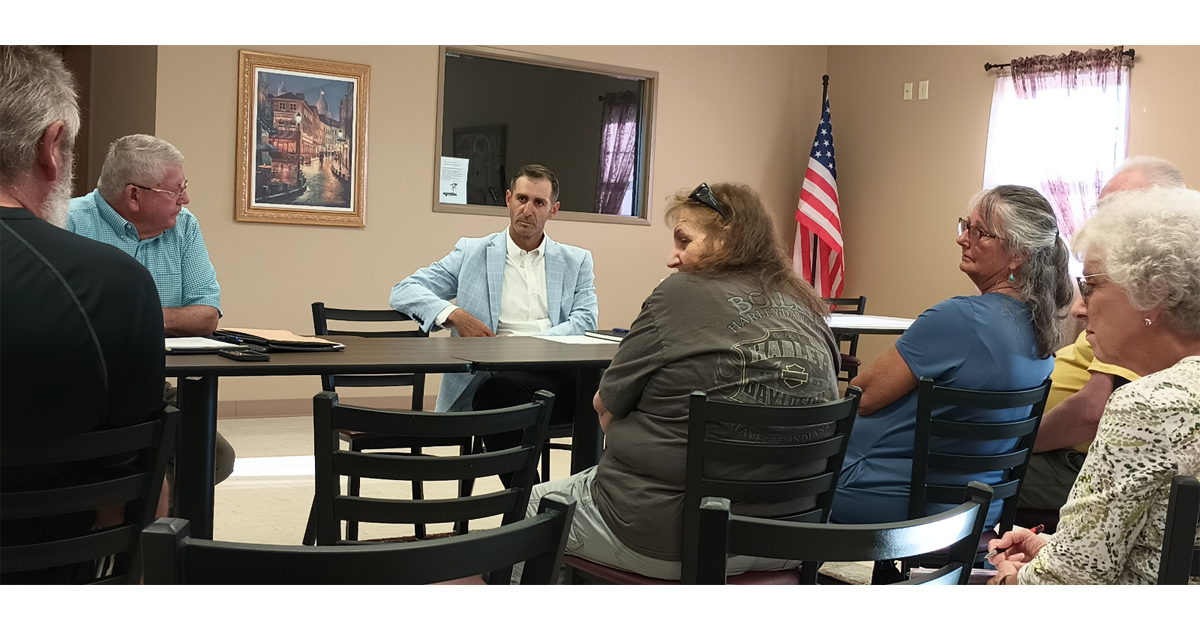
Clinton County Commissioner Jordan Brewer speaking to a group at the Paul Phillippe Resource Center Wednesday morning September 10, 2025, informed those in attendance that he intends to vote "no" on the proposed data center project. (photo/Brett W. Todd)

FRANKFORT, Ind. (September 10, 2025) — Clinton County Commissioner Jordan Brewer speaking to a group at the Paul Phillippe Resource Center Wednesday morning informed those in attendance that the Clinton County Commissioners will not be voting on the data center September 16.

He said the reason not to vote is due to his not being in attendance and the desire that all three Commissioners need to be present. Liz Stitzel, area plan director for the county, will attend the September 16th meeting to present the “no” or “neutral” recommendation of the area plan commission to the commissioners. Indiana law requires the recommendation to be presented and the commissioners then have 90 days to vote on the measure.

Brewer further stated that the topic will come up at either the first or second meeting in October. His personal feelings are Doug Swain, the developer of the data center project, “cannot be trusted” and will be voting “no” when the topic does come up.

The data center project, initially presented to the city-county PIP (Partners in Progress) board in a brief 20-30 minute “speed dating” style of meeting in May, involves the rezoning of 115 acres by the city. Brewer highlighted that the developer proceeded with city planning meetings in July without informing county commissioners, leading to a breakdown of trust. He recounted telling the developer in a July 25th meeting that the developer had “effed this whole thing up” by making commissioners appear dishonest to the public.

A key concern for Brewer is the unknown “end user” of the data center. He stated the county’s consistent stance against rezoning without knowing who they are dealing with, as changes become “limited” once rezoning occurs. He gave a hypothetical example of a developer proposing one-story buildings, only for an end-user to demand 50-story structures, which would be difficult to stop once zoning is approved.

The developer of the data center is hosting a public meeting on Monday, September 15, 6 pm, at Willow Creek Barn located at 1575 Kirklin Brick Rd., Frankfort.

Several other matters were discussed at the public gathering.

Senior Services Funding: The Paul Phillippe Senior Center received $5,900 from the county this year, part of $100,000 allocated by the County Council for various community requests that typically exceed $150,000. Overall funding for the Senior Center primarily comes from United Way, totaling $19,000 annually.

A committee at the Senior Center prepared a report which highlighted that other counties provide significantly more, with some supporting senior services with hundreds of thousands of dollars. The county’s funding originates from landfill tipping fees, which provide roughly $1 million per year, though the portion allocated to commissioners has remained stagnant since 2017-2018. A renegotiated contract will introduce CPI (consumer price index) increases every other year starting in 2026.

Annex Building Construction: The county’s new annex building is slated for an October move-in, though the timeline was not met due to “craftsmanship” issues and what Brewer described as a lack of “pride in our ability to do things well anymore.” Many “little things” required fixing by subcontractors, not structural issues. The project manager for the annex will not oversee the courthouse renovation due to a perceived failure in holding subcontractors accountable; however, Envoy will continue on and serve as general contractor for the courthouse renovation. Brewer mentioned significant time was spent on minute details like interior signage to meet ADA and braille requirements.

Hydroponics Lettuce Development: A proposed hydroponics lettuce development south of NHK on I-65 has been in discussion for one and a half to two years. While it has a broader vision for an “ag tech park” designated by the Indiana Department of Agriculture, it has not yet secured a commitment letter and has not asked for abatements. Brewer noted that the project is largely automated, leading to few jobs.

Its funding, tied to an insurance company in China, has reportedly been held up due to US-China relations. The project is expected to use 300,000 gallons of water per day, which would help circulate water in an empty water tower in the area. Frankfort Utilities has kept the tower empty due to having to dump water from the tower due to lack of water usage in the area.

Kellys, Sommer Legal Battle Moves Forward After Appeals Court Reinstatement

A long-running public dispute between Clinton County Sheriff Richard Kelly (right in photo) and County Prosecutor Anthony Sommer is progressing in court, with the parties recently ordered to establish case management deadlines following an appeals court decision to reverse an earlier dismissal. The Boone County Circuit Court has directed both sides to submit an Agreed Case Management Order within 30 days of August 26, 2025, after a scheduled telephonic pre-trial conference was not attended by either party. (photo/Facebook)

FRANKFORT, Ind. – A long-running public dispute between Clinton County Sheriff Richard Kelly and County Prosecutor Anthony Sommer is progressing in court, with the parties recently ordered to establish case management deadlines following an appeals court decision to reverse an earlier dismissal. The Boone County Circuit Court has directed both sides to submit an Agreed Case Management Order within 30 days of August 26, 2025, after a scheduled telephonic pre-trial conference was not attended by either party.

Case Background:

The legal battle stems from a deterioration of the relationship between Sheriff Kelly and Prosecutor Sommer, which began shortly after Kelly took office in January 2019. Initially friendly, their relationship soured over disputes regarding law enforcement authority in Clinton County. Prosecutor Sommer later campaigned against Sheriff Kelly in the 2022 election and contributed to his opponent.

A key point of contention arose when Sheriff Kelly appointed his wife, Ashley Kelly, as both Jail Matron and Jail Commissary Manager. Under this arrangement, Mrs. Kelly received $1,500 per week for each role, totaling $3,000 weekly. Sommer raised concerns about this arrangement and requested an investigation by the Indiana State Board of Accounts (SBOA) into the jail commissary setup and operation.

In October 2021, local journalist Brett Todd published an article on RadioMom-fm regarding the SBOA investigation, quoting County Commissioner Josh Uitts, who stated that Mrs. Kelly was paid $1,500 per week to manage the commissary, an amount he considered inappropriate. “So we don’t feel that is appropriate amount of money for that type of work. You do the math – that is $1,500 a week for 52 weeks. That’s more money than any county employee makes. This is a contractor – an appointed person by the sheriff, so we don’t feel it’s appropriate.”

Todd’s article, however, also noted that six other Clinton County employees earned in excess of $1,500 per week in 2020.

Prosecutor Sommer, believing the reported salary information for Mrs. Kelly was incomplete because it did not include her matron salary from the county, contacted the journalist to “correct the record and provide additional information in order to keep things balanced.” During an October 8, 2021 meeting, Sommer clarified that Mrs. Kelly’s total compensation was $3,000 per week, accounting for both roles. Sommer provided Todd with a “Commissary Transaction Summary for the first half of 2021,” which he stated was a Council document prepared from numbers reported by the Sheriff’s Office. The Kellys claim this document was “fake” and appeared to show “transfers and disappearances of millions of dollars.” Sommer denies the report was fake or showed such disappearances, acknowledging only one error (an extra digit) he was unaware of at the time.

Sommer also informed Todd that he did not want to be recorded or quoted in any story and that he was not providing information or comment on the ongoing audit and criminal investigation because they were confidential and ongoing. He further stated that if criminal wrongdoing were found, the Clinton County Prosecutor’s office would refer the case to a Special Prosecutor, and it would not be him weighing in on the matter.

The Lawsuit and Appeal:

Richard and Ashley Kelly subsequently filed a lawsuit against Anthony Sommer, alleging defamation and intentional infliction of emotional distress. They claimed Sommer engaged in a political scheme, coordinated with Attorney Thomas Little, to defame them by sharing a fabricated report. Sommer denies these allegations, denying any coordination with Attorney Little and stating he was not attempting to control the media narrative. He also asserts that all statements he made were accurate, honest, and truthful.

Sommer moved to dismiss the complaint, asserting common law prosecutorial immunity and immunity under the Indiana Tort Claims Act (ITCA). The trial court granted the dismissal, finding Sommer’s actions were protected by common law immunity.

However, on March 5, 2025, the Indiana Court of Appeals reversed the trial court’s dismissal. The appellate court determined that the application of immunity hinged on disputed factual questions about the nature and scope of Sommer’s conduct as it related to his prosecutorial function, which remain unresolved. The court noted that, viewing the pleaded facts in the light most favorable to the Kellys, Sommer used his official position to share allegedly fabricated documents about an investigation his office was not handling, while disclaiming official involvement and requesting an off-the-record meeting. Such actions, the court found, “appear more aligned with personal interests than any legitimate prosecutorial duty.” The court also concluded that whether Sommer’s conduct fell within the scope of his employment for ITCA immunity purposes remains a question of fact for a jury.

Current Status:

Following the Court of Appeals’ certification of its opinion on May 2, 2025, Sommer filed a motion on June 4, 2025, to set a deadline for his answer to the complaint, which the court granted, setting the deadline for July 3, 2025. Sommer filed his comprehensive answer, affirmative defenses, and demand for a jury trial on that date, denying the plaintiffs’ allegations of defamation and intentional infliction of emotional distress and asserting various defenses, including prosecutorial immunity.

On August 11, 2025, Sommer’s counsel filed a motion to set an initial telephonic pretrial conference to establish case management deadlines. While a conference was scheduled for August 26, 2025, neither party participated. Consequently, the Boone County Circuit Court issued an order on August 26, 2025, directing the parties to submit an Agreed Case Management Order within 30 days. This order requires the parties to address the jury trial timeframe and anticipated length, discovery cut-off dates, witness and exhibit list exchange, motions in limine, proposed jury instructions, written stipulations, and whether mediation is requested.

The case is now proceeding towards the establishment of a trial schedule and discovery, with the factual disputes surrounding Sommer’s conduct to be further explored.

Note: The journalist mentioned in the article is the author of this article.

Clinton County Area Plan Commission Delivers ‘Neutral’ Stance on Logix Reality Data Center Rezoning

Members of the Clinton County Area Plan Commission has opted to send a "no" or "neutral" recommendation to the Clinton County Commissioners regarding a contentious request by Logix Reality LLC to rezone a 154.92-acre agricultural parcel for a potential data center. The decision was reached after a lengthy public hearing at the Clinton County courthouse on September 2, 2025. In the photo from left to right are: Dan Sheets, Jeff Chynoweth, Kevin Myers and Walt Minnick. (photo/Brett W. Todd)

FRANKFORT, Ind. (September 2, 2025) — The Clinton County Area Plan Commission has opted to send a “no” or “neutral” recommendation to the Clinton County Commissioners regarding a contentious request by Logix Reality LLC to rezone a 154.92-acre agricultural parcel for a potential data center. The decision was reached after a lengthy public hearing at the Clinton County courthouse this evening.

The application, CC-2025-00787 (Docket # 15-25-RZ), sought to rezone land from the A-1 Agricultural Zoning District to the I-1 Light Industrial Zoning District. The proposed site is located on the south side of County Road 100 North, between 450 West and 300 West, in Washington Township. It is adjacent to a railroad and the ConAgra industrial park, with surrounding land zoned a mix of agricultural and industrial.

Liz Stitzel, Clinton County Area Plan Director, presented a detailed report outlining several considerations.

The staff report noted that the site’s location is appropriate for industrial zoning, given its adjacency to Frankfort’s corporate line, existing industrial areas, and the railroad. It also benefits from available sewer, water, and electrical capacity. The site is within a Tax Increment Financing (TIF) district, where development is anticipated to fund infrastructure improvements.

Significant concerns were raised about the readiness of drainage infrastructure, with no comfortable plan submitted to the county surveyor. County Road 100 North, a single-lane gravel road, was deemed insufficient for heavier or higher industrial traffic volumes, and no plan for its upgrade had been provided.

The report highlighted the need for plans to mitigate potential effects on four existing homes to the north and two legal non-conforming homes to the south that are currently zoned industrial.

A proposed new substation to the south, while not directly on the rezoning site, was noted as important for the project’s success, with questions about the acquisition of two legal non-conforming homes it would replace.

Staff initially recommended a one-month continuance to allow the applicant to address these critical information gaps. If no continuance, a nuanced negative recommendation was suggested, acknowledging comprehensive plan support but citing infrastructure unreadiness and unaddressed mitigation for incompatible uses.

Applicant’s case and public response made by John Moore, attorney for Logix Reality LLC, and Doug Swain of Logix Reality, emphasized the potential benefits of a data center.

Swain projected about $1.5 billion in investment, generating approximately $265 million in gross property tax revenue over 25 years and $6.3 million in local income tax. He estimated around 170 full-time employees with an average salary of $85,000 per year, noting a strong incentive for some to live locally, up to 35-percent of the workforce could live in the county.

Swain described data centers as a “cleanest, most simplest form of industrial,” producing no pollution, minimal noise (around 65 dB), and not much water use due to modern closed-loop cooling systems. He stressed that power would come from dedicated lines with costs borne by the developer/user, not local citizens.

The applicant’s representatives expressed willingness to work on drainage, improve County Road 100 North, provide buffering beyond ordinance requirements for residents, and limit certain industrial uses on the site. Swain apologized for not contacting residents earlier, acknowledging it was a mistake.

Swain stated the primary tax incentives are state-granted sales and use tax exemptions for equipment, which is state revenue, not local. He stated that Logix Realty LLC has not approached city and county officials regarding property tax abatements. However, he acknowledged that the end users might ask for local property tax abatements given the large investment.

The meeting saw a turnout of approxiamtely 125 residents with strong public opposition and concerns.

Residents expressed a desire to preserve the land as farm ground and emphasized Clinton County’s identity as a “farming community.” Concerns about water supply were prominent, with fears of wells running dry and the non-recyclable nature of water used. Electricity burden and potential brownouts were also cited.

Another resident claimed data centers produce about 92 dB of noise, comparable to a motorcycle. While another resident raised concerns about light pollution impacting the Prairie Grass Observatory.

Many speakers criticized the lack of information provided to the public and homeowners, stating they felt excluded from the process. Concerns were raised about tax abatements and the need for independent studies.

Two speakers argued that using public money for economic development, such as data centers, is unlawful and without constitutional authority, citing Supreme Court cases and state constitutions.

After hearing the comments from the public and the applicant, the Area Plan Commission first denied a motion for a 30-day continuance made by member Jeff Chynoweth for lack of a second. A subsequent motion to send a negative recommendation to the County Commissioners failed with a 3-1 vote, as four “yes” votes were required for action.

After further discussion on the options as presented by Stitzel, including the possibility of sending “no” recommendation, the board ultimately voted unanimously to pass a “neutral” or “no” recommendation to the County Commissioners. The County Commissioners, who have broader discretion in considering all factors, have 90-days to make a final decision on the rezoning request.

The next regularly scheduled meeting of the Clinton County Commissioners will be September 16th at 9 a.m. in the courthouse.

Banderas Point Development Stalls: Funding Woes

Developers behind the Banderas Point project, Good Oil Company, at Interstate 65 and State Road 28 are currently facing a significant financial setback according to Commissioners President Jordan Brewer, leading to a halt in activity at the site. The project reportedly lacks the necessary financial backing to proceed. (image/provided)

FRANKFORT, Ind. (August 27, 2025) — Developers behind the Banderas Point project, Good Oil Company, at Interstate 65 and State Road 28 are currently facing a financial setback according to Commissioners President Jordan Brewer, leading to a halt in activity at the site. The project reportedly lacks the necessary financial backing to proceed.

According to Brewer, speaking to a group in Kirklin in July, there has been “not much activity” at the project site near I-65 and State Road 28. When questioned about the project’s status and the potential for new restaurants in the area, Brewer indicated that the developers “do not have the financial backing to move forward at the moment.” He clarified that while he was unsure if the project was “canceled,” the developers “just don’t have money right now to do anything more.”

Brewer recounted an instance where a Hilton-brand hotel was interested in locating at I-65 and State Road 28. The developer of the hotel was seeking to purchase a parcel of real estate from the developer of Banderas Point and required a 10.5% return on investment. The county was asked if it would contribute financially every year to meet that. The county declined. Brewer stated, the county “didn’t feel like that was a great return for Clinton County to give them money every single year just for a hotel” for the developer to make their desired profit margin. Consequently, “there’s no hotel” at that location.

Adding to their current challenges, the developers are still required to complete an incomplete retention pond at the site. Brewer noted that the Indiana Department of Environmental Management (IDEM) is expected to compel them to finish this task.

The area at I-65 and State Road 28 has seen significant infrastructure investment, including a $3 million water tower and $35 million for sewer and water, primarily funded by the county, plus a multi-million dollar roundabout east of the I-65 interchange.

Stitzel Talks Moratorium on Battery Farms and Wind Turbines, Upcoming Data Center Public Hearing

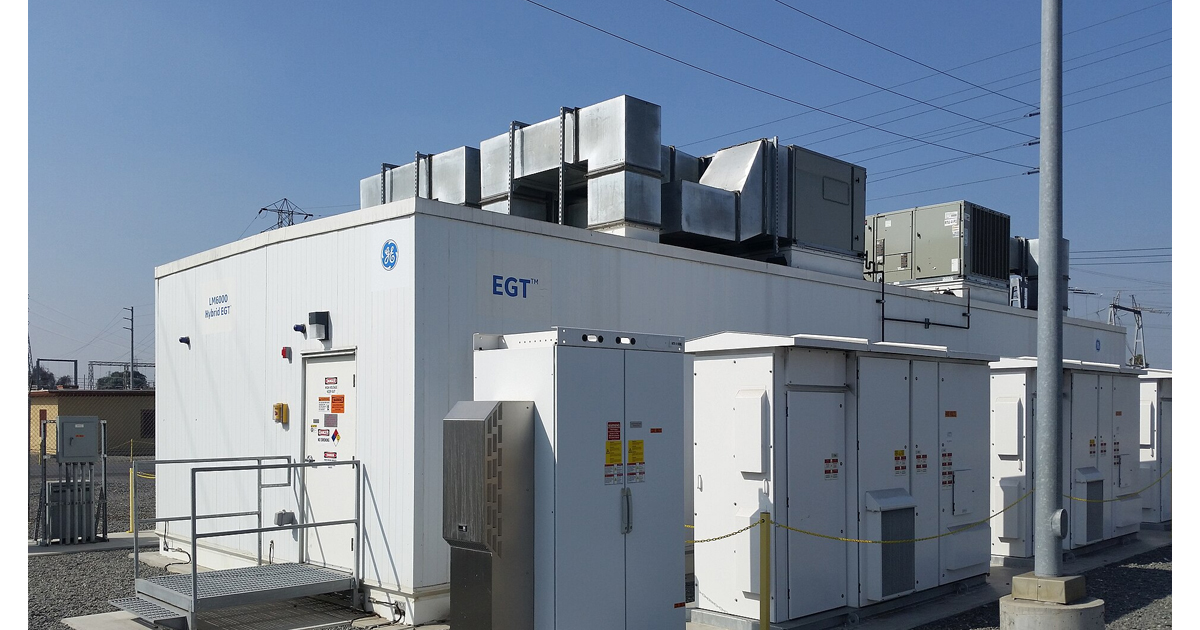
Clinton County has enacted a moratorium on new battery energy storage system (BESS) developments, commonly known as battery farms, to allow officials time to draft specific zoning ordinances for the emerging technology. The measure is designed to create a regulatory framework for these facilities, not to block their development, according to Liz Stitzel, the Clinton County Area Plan Director. 9photo/Wikipedia)

CLINTON COUNTY, Ind. (August 26, 2025) — Clinton County has enacted a moratorium on new battery energy storage system (BESS) developments, commonly known as battery farms, to allow officials time to draft specific zoning ordinances for the emerging technology. The measure is designed to create a regulatory framework for these facilities, not to block their development, according to Liz Stitzel, the Clinton County Area Plan Director.

Battery farms are designed to address imbalances in the U.S. electric grid, storing excess electricity when production outstrips demand and discharging it during peak hours or outages. Stitzel explained that this prevents energy waste and can provide crucial backup power, potentially supplying four to six hours of electricity during a substation failure, thereby preventing “life-threatening power loss or inconvenience.” These systems are typically found near large power generation sites (nuclear, coal, solar, wind, water dams) but are also appearing on smaller grid lines.

The moratorium, a tool to “pause development” while ordinances are prepared, is crucial because existing county regulations do not adequately address battery farms. Under state law, a moratorium cannot be a permanent ban and is limited to one year, as a ban would be considered an illegal “taking” according to Stitzel. Without specific rules, new applications would be processed under the “most similar rule,” likely falling under solar or wind ordinances. However, Stitzel noted, battery farms are “really pretty different from both” solar and wind, with distinct characteristics that don’t align with existing setback or design requirements for those technologies.

“It’s not about wanting or not wanting something,” Stitzel said, but about ensuring the county has “a set of rules that allows us to consider something honestly in something that big in a hearing format rather than just issuing a permit and not having any opportunity for public input.” For instance, without the moratorium, a battery farm at an existing solar site might be issued a permit as a permitted use, bypassing public review.

Stitzel clarified a common misconception regarding wind development in the county, stating “there was never a wind moratorium adopted.” Instead, the county’s ordinance requires economic development and road agreements with county commissioners before wind rezoning applications can proceed. The commissioners have “simply refused to negotiate,” effectively halting wind projects without a formal moratorium.

For large-scale projects, Stitzel advocates for a rezoning process, which allows decisions to be made by the legislative body (County Commissioners) who are accountable to voters. Unlike the Plan Commission, which is restricted to land use and comprehensive plan considerations, the legislative body can weigh a much broader range of factors, including financial and fiscal impacts to the community. Stitzel cited the landfill expansion as an example, where commissioners approved the project despite a negative Plan Commission recommendation, considering the broader economic impact and public welfare, including preventing community fiscal issues from a previous operator’s liabilities.

Public participation is a cornerstone of the process. Stitzel emphasized her job is to ensure “a fair hearing and a process where people can get at least the information we have.” For an upcoming September 2nd hearing on a data center, the petition from Logix Reality, LLC is for approximately 150 acres north of ConAgra to be rezoned from A-1, Agricultural to I-1, Light Industrial, Stitzel anticipates a crowd of 80 to 150 people. While the courthouse chambers can accommodate around 100, she affirmed that if an unexpectedly large crowd, potentially hundreds, were to attend, the hearing would be continued to a larger venue to ensure everyone can hear and participate, even if it means rescheduling. Past large hearings, such as the landfill (700 people) and wind projects (500-600 people), necessitated larger venues like the fairgrounds. Solar projects generally draw smaller crowds of 100-200 people.

Stitzel maintains a neutral stance in her role, stating her job is not to approve or disapprove, but to facilitate a fair process and provide recommendations based on data and planning logic, even if it differs from personal opinions.

Tipton County Judge Hears Oral Arguments in Rokita, Kelly Case

A hearing took place on August 21 in front of Tipton Judge Thomas Lett to consider a motion for summary judgment and to strike evidence filed by the State of Indiana against Clinton County Sheriff Richard Kelly, his wife Ashley Kelly, and their LLC, Leonne, regarding alleged misappropriation of jail commissary funds. (photo/Brett W. Todd)

TIPTON, Ind. (August 25, 2025) – A hearing took place on August 21 in front of Tipton Judge Thomas Lett to consider a motion for summary judgment and to strike evidence filed by the State of Indiana against Clinton County Sheriff Richard Kelly, his wife Ashley Kelly, and their LLC, Leonne, regarding alleged misappropriation of jail commissary funds. The State, represented by the Attorney General’s office, is seeking to recover over $329,000, including audit costs, stemming from an investigation into the use of commissary profits. The defendants vigorously oppose the motion, arguing their actions were lawful, based on professional advice, and that the State’s case lacks the necessary element of intent.

The Attorney General’s office, represented by attorneys Marielle Riedle and Shana Tesnar, announced the State would only seek summary judgement on Count One (Malfeasance, Misfeasance, and/or Nonfeasance) and forgo the request to Counts Two thru Five to keep their arguments “clean and concise.” Count Two was the request for Treble Damage and could have seen the State recover three times the original amount, in excess of $800,000. Count Three dealt with Unjust Enrichment while Counts Four and Five were claims against the individual Bond holders which the county had taken out for Sheriff Kelly and Ashley Kelly.

The State continued by stating the facts in this case are “undisputed.” They highlighted a trial court’s declaratory judgment and a Court of Appeals decision which found that payments from commissary profits were made without necessary county approval.

Attorney Riedle emphasized that for the primary charge (malfeasance, misfeasance, or nonfeasance) criminal intent is not a required element. They highlighted a prior ruling stating that recovery of misappropriated funds is “irrespective of whether the person who wrongfully received public money knew that he or she was not lawfully entitled to receive it.” The State also moved to strike the defense’s affidavits and exhibits, citing issues with proper designation, timeliness, and authentication.

Theodore Minch, attorney representing Richard and Ashley Kelly, addressed the court saying “multiple attempts to obtain documents which are relevant to Count One” were made available on the eve of the criminal trial in April by “third party” discovery from Clinton County Prosecutor Anthony Sommer and Attorney Thomas Little. He added Boone County Judge Lori Schein issued a “denial of protective order a day or two ago” in the criminal case involving the Kellys. According to Minch, those documents are now available for the State to review in the Tipton County case. He said in regards to striking the evidence it is “responsive evidence in of itself” that the motion is “abuse of Trial [Rule] 56” and the Kellys authenticate the very documents in their “affidavits.”

Minch continued saying mens rea or criminal intent is moot because “there’s been no malfeasance, there’s been improper conduct.”

On December 18, 2018, Attorney Little sent a text message to Richard Kelly with regards to a conflict form, which is at the “crux of the criminal case and the malfeasance as alleged by the attorney generals office”, and asked for the Kellys address. Unknown to the Kellys, at a “public meeting” held on December 27, 2018, the commissioners “met” and placed the conflict form “on the agenda” and the item was “heard for two-and-half minutes” and the conflict form “was accepted.”

Regarding the commissary contracts, Minch said those contracts have been “tendered and approved” under the “same terms” used by sheriff’s prior in Clinton County adding Ashley Kelly was last paid on September 15, 2021, under the “contracts the State alleges had not been accepted or approved by the commissioners.”

The State’s case is “predicated” on a SBOA report that “frankly is factually incorrect, never been corrected,” continued Minch. Adding, “we now have emails showing red-lining.” The Court of Appeal decisions that the State cited are part of an “ongoing litigation” that [Brian] Dehem (attorney for the Kellys in lawsuits against Sommer and Little) is now “being challenged” as a result of this new discovery having been “brought forth.”

Judge Lett took the matter under advisement and will review all written documents and arguments. He gave each side 14-days to issue proposed orders and will issue an order as soon as possible.

Developer of Data Center Files Petition with Area Plan Commission, Hearing Set for September 2

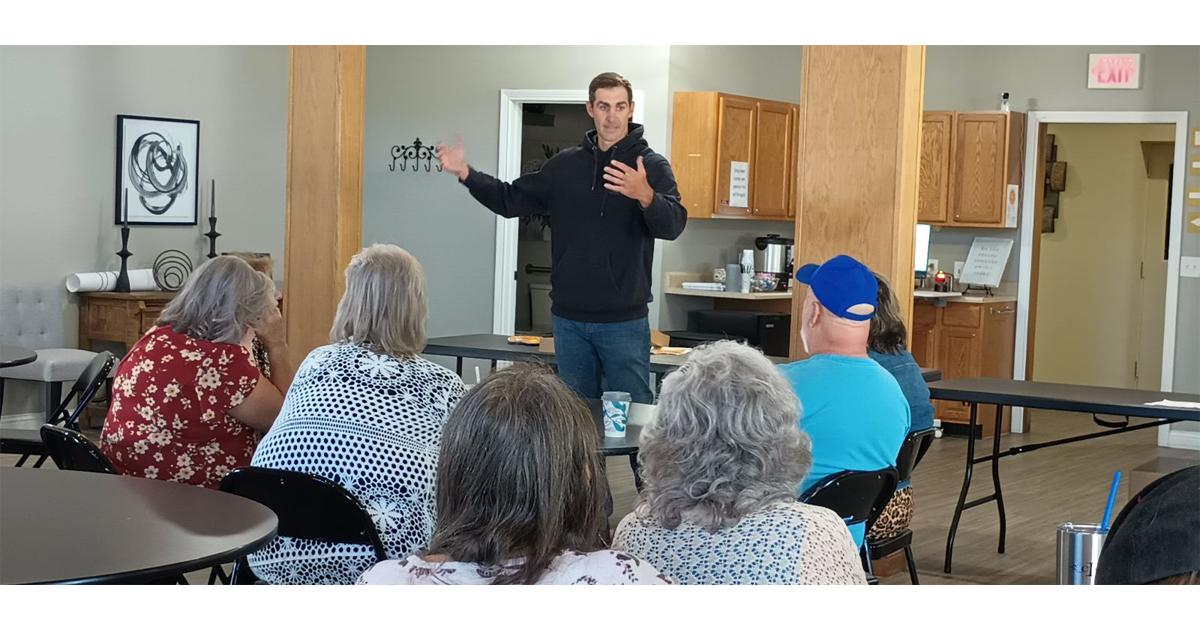
Clinton County Commissioner Jordan Brewer addressed a community meeting in Rossville Thursday evening, offering insights into the proposed data center project and engaging residents on broader issues of economic development, water resources, and public participation. The "Convo with a Commish" event, a format designed for open dialogue, saw the commissioner candidly discuss the complexities of balancing growth with community values. (photo/Brett W. Todd)

ROSSVILLE, Ind. (August 14, 2025) – Clinton County Commissioner Jordan Brewer addressed a community meeting in Rossville Thursday evening, offering insights into the proposed data center project and engaging residents on broader issues of economic development, water resources, and public participation. The “Convo with a Commish” event, a format designed for open dialogue, saw the commissioner candidly discuss the complexities of balancing growth with community values.

Data Center Development Under Scrutiny

The controversial data center proposal, spearheaded by developer Logix, is seeking to establish a large-scale operation in Clinton County.

• A 115-acre parcel of land in the city of Frankfort, east of Conagra, has already been rezoned for a data center by the city, a move that occurred with little public attendance at initial meetings. This city project, if an end-user is found, is projected to be a $1.4 billion investment over six years, potentially using one million gallons of water per day.

• Brewer stated he believes Frito Lay uses an estimated 1.5 to 1.6 million gallons of water per day when asked. He noted that this figure is not exact, but he believes they are the largest user within the city’s infrastructure.

• Logix has now filed a petition with the Clinton County Area Plan to rezone an additional 150 acres adjacent to the previously rezoned city property. This county proposal is expected to be reviewed at the September 2nd Area Plan meeting.

Commissioner Brewer expressed significant frustration with the developer’s approach, stating they “effed this whole thing up” by moving too quickly without providing adequate information. He noted that typically, such projects involve numerous in-depth meetings before reaching the public. Brewer also reiterated the county’s historical stance against rezoning land without a known end-user, to prevent broad zoning that could allow for undesirable industries. When asked how he would vote today on the county’s proposed rezoning, Brewer stated he would not vote yes due to the lack of an end-user and limited information.

Water Supply: A Growing Concern

A major point of contention from residents was the potential impact on local water supplies, specifically the Tippecanoe River Basin aquifer. Residents highlighted that the nearby LEAP project in Lebanon is slated to pull 100 million gallons of water daily, while Tippecanoe County currently uses 35 million gallons per day.

While Frankfort utilities have conducted an aquifer study, Commissioner Brewer stated he has not seen it, and it is not publicly available. He noted that a prior study, related to the LEAP District exploring Clinton County as a water source, indicated the county could only supply 10 million gallons per day from tested areas. Brewer acknowledged the difficulty of conducting a county-wide water study, estimating it would cost “six figures” and would require access to private land. He questioned who would be accountable if a study proved inaccurate over time.

Economic Development and Community Vision

The discussion broadened to the county’s overall economic development strategy, particularly along the I-65 and State Road 28 corridor, where the county has invested $35 million in utility infrastructure. Commissioner Brewer indicated that the focus shifted to this area due to this significant investment.

However, he also expressed a personal vision for growth centered around the county’s small towns like Rossville, Kirklin, and Mulberry, rather than sprawling development across rural farmland. The recent Senate Bill One, aimed at property tax relief, has changed the “rules of the game” for economic development, shifting the emphasis from assessed property value to population growth (income tax). This new dynamic, Brewer suggested, might make investing in infrastructure for housing more appealing, especially for homes valued at $300,000 to $500,000, which are needed to generate sufficient tax revenue to offset services.

Residents expressed a desire to preserve Clinton County’s rural character, citing it as a primary reason for choosing to live there. One resident stated that “carbon sequestration, data centers, lithium mining, like are all things that they don’t want because it goes against that rural type feel”. Commissioner Brewer challenged attendees to articulate not just what they don’t want, but “what do you want” for the county’s future and its ideal population size.

Public Engagement and Voting

The meeting underscored the importance of public involvement in local governance. A Frankfort city employee highlighted that voter turnout in primary elections is “inexcusable,” ranging from 23% to 27%. She emphasized that voting is the primary means for citizens to influence elected officials and shape community outcomes. Residents were encouraged to actively seek information, attend meetings (which are often available online), and review agendas, as official public notices are often limited to local newspapers.

Other Development Considerations

Other topics touched upon included:

• Solar Farms: The large-scale solar project near Rossville was noted as being “all but dead,” with no recent activity. The commissioner differentiated this project, owned by a New York investment company, from other solar developments (Hardy Hills) where local landowners are involved.

• Battery Storage: Concerns were raised about lithium battery storage, particularly fire risks and the need for specific zoning regulations. The county is working on a moratorium to develop specific zoning for battery storage, as current ordinances lack clear classifications.

• Agricultural Future: Discussion included the challenges of monocropping, the need for diversified agricultural processing, and the changing labor force in farming. Commissioner Brewer also noted the increasing trend of land being used as an investment tool rather than solely for production.

Go to Top