Category archive

Frankfort Municipal Utilities - page 2

USB Sets Date For Water Rate Increase
The Frankfort Utility Service Board (USB) took action at its Tuesday, September 8, 2020, meeting to set the effective date of the water rate increase. The water rate increase will be implemented over a three year period and when fully implemented will amount to a 53.6% increase.

Frankfort Municipal Utilities General Manager Todd Corrie addressed the 5-member board.

“I think our plan of right now if you guys are good with it, is to start it October 1st of this year – that way it starts right clean at the month, the 1st of the month,” said Corrie. “It will be the first one, then we will have it in our record for October 1st, 2021, then October 1st, 2022.”

The first increase will be 25%, the second increase is 15%, and the final increase is 13.6%.

According to a document prepared by a consulting firm hired by the USB, Stifel, Nicolaus & Company, Inc., the current rate for a city user of 4 units monthly is $10.28 per month. Under the new increase, that user will see the rate go to $12.85 per month in year 1, $14.39 per month in year 2, and $15.79 per month with the final increase.
Frankfort City Council Approves 53.6% Increase To Water Rates

The Frankfort City Council took the final two-steps to increase water rates by 53.6% at its Monday, August 24, 2020, Council meeting. After holding a public hearing on Ordinance 20-13, the Council voted 6-0 approving the new water rate.

The water rate increase will be phased in over 3-years.

After the meeting, Todd Corrie, General Manager of the Frankfort Municipal Utilities, was ecstatic the 3-year process of developing plans for much-needed work on the existing water system was completed.

“I am very happy that this is done, ecstatic,” said Corrie. “It has been a long process. We have been working on this probably for 3-years now.”

Over $13,600,000 is needed to expand and begin repair of the current Frankfort water network. This need is being driven by a forecasted demand in water usage over the next 20-years and the current condition of the system.

Corrie discussed how the new funds will be used.

“There’s going to be an upgrade to the plant. It’s going to go from 6 million gallons to 9 million gallons a day. We are going to finish off something that we call the Jefferson Loop. It is connecting from Jefferson back around to the industrial park off of County Road 0.”

He also added the increase will help in making the plants safer and allow for the replacement of existing water main.

“We’re going to go to an on-site generation for our chlorine. Then, we have money in there to rehabilitate one of the water towers and then be saving money with this to do the next one probably 5 years down the road. Also be in place to replace water mains at a rate of maybe a mile a year is what we’re going to be shooting for and it is all very expensive.”

When asked when ratepayers should expect to see the increase, Corrie said the topic will be discussed at the next Utility Service Board meeting.

“We are going to discuss this at our next Utility Service Board and it (the rate increase) will be sometime between September and October 1st.”

The next USB meeting will be Tuesday, September 8, 2020, at 7 p.m.

Disconnections To Resume September 15th, Repayment Plans Available

At the Monday, August 17, 2020, Frankfort Utility Service Board meeting, the members voted unanimously to set September 15th as the date to resume utility disconnections.

Stacy Uitts, Frankfort Billing Office Manager, noted there are approximately 437 customers eligible for disconnection.

Those who are behind are encouraged to contact the billing office to schedule an appointment to discuss repayment plans. Repayment plans are available for up to 6-months in length to assist in keeping payments low. The repayment plan is in addition to the monthly usage bill according to Mike Kelley, Chairman of the Frankfort USB.

Below is the complete press release issued by the members of the Frankfort USB:

As of August 14, 2020 Governor Holcomb’s orders concerning disconnects expired. Frankfort Municipal Utilities has decided to extend these orders until September 15, 2020 to give our customers an opportunity to make payment arrangements if needed.

Effective September 15, 2020, disconnections will begin again. All past due payments must be taken care of before 10:00 am on September 15th to avoid any interruption in service. If you are unable to make the full payment we are offering 6 months payment plans, but they must be set up before September 15, 2020 by contacting Frankfort Municipal Utilities Billing Office in person or by phone to avoid being disconnected. Frankfort Municipal Utility Billing Office located at 1405 E Wabash St, and the phone number is 765.659.3361.

You may also contact Area IV 765.447.7683, and your local township trustee’s office for additional assistance Center Township 765-357-9100.

All late penalties and fees will resume on October 14, 2020.

If you have any questions or concerns, please contact the FMU Billing Office.

Thank you,
Utility Service Board
Mike Kelley, Chairman
Kent Brewer, Vice Chairman
Joe Root
Mike Reeder
Rick Gunyon

FMU Personnel
Todd Corrie, General Manager
Stacy Uitts, Billing Office Manager

Lagoons May Reopen May 24th If Clinton County Moves To Stage 3 of IN Governor Eric Holcomb’s Plan

The USB voted 5-0 Monday night during its scheduled meeting to reopen the Lagoons provided Clinton County moves to Stage 3 under Indiana Governor Eric Holcomb’s plan to getting Indiana reopened.

Stage 3 is set to take place on May 24th.

However, Governor Holcomb’s executive order does allow local government to set rules that are more strict if they deem necessary.

Safety of Utilities Employees Cited As A Reason Why USB Continues To Keep Lagoons Closed

The five members of the Frankfort Utility Service Board issued a press release, Thursday, May 7, 2020, addressing the closure of the Frankfort Lagoons.

Below is the press release in its entirety.

The Frankfort Lagoons were created years ago as the answer to sewage treatment issues created by a local industry. Their purpose was to collect and hold water used by that industry to be disposed of without processing the water through the entire sanitary sewage treatment process. After the industry closed, the infrastructure conveying the water to the Lagoons was incorporated into the storm water drainage system for a section of the city. The storm water and water supplied by electric powered wells are the main water sources for the Lagoons today. The Lagoons continue to be maintained and operated as a part of the utility infrastructure in the City.

In the 1970’s, the Utility Service Board (USB) was created by the Frankfort City Council to oversee the Frankfort Water Works, Frankfort Light and Power, Wastewater Treatment Department, and Sewer Maintenance Department. More recently, the Fiber Optic Network was added to the Board’s responsibility.

There are five members on the Board. Three are appointed by the Mayor and two by the City Council. Per state statute, the Board is responsible for supervising the utilities to ensure that the operation of the utilities is in the best interest and to the benefit of the ratepayers. Policymaking regarding the operation of the utilities, its real estate, and its infrastructure is part of the supervisory powers granted the Board. Since the temporary closing of the Lagoons is a policy made by the Board and since the Lagoons fall under the umbrella of the utility infrastructure, the USB, not the Mayor, not the City Council, and not the Department of Natural Resources will provide the rationale for the decision and will continue to serve as the decision maker with regard to the Lagoons.

In the beginning, Governor’s Executive order declared, among many things, that people should stay at home, limited public gathering, and asked that certain types of places be closed to the public. With this order in mind, the USB felt it was in the best interest of the public and more importantly of its employees, that the Lagoons be closed. A significant factor in the closing was, and continues to be the fact that employees of the utilities are ultimately responsible for the care, maintenance, and trash removal for the Lagoons. The USB also is thankful for and mindful of the many volunteers who have routinely assisted in cleaning up the trash and hazardous items left in the area. Why would the USB want to put any of these employees’ or volunteers’ health in jeopardy? After considering the safety of the employees, the volunteers, and the public, the decision was made to close the Lagoons. Recently some of the Governor’s restrictions were amended to allow more activities, but there was also a provision for local authorities to utilize a slower process to reopen to the public. After considering the increase in the reported cases most recently in Clinton County, the USB decided to keep the Lagoons closed at this time, but to review the current data as it becomes available, and to reopen the Lagoons when employees, volunteers, and the public face minimal health risk. The health and safety of the employees, volunteers, and the public are matters of great importance to the USB. The USB appreciates the public’s understanding and cooperation during this time of public health emergency. We will continue to analyze the situation as it arises and will make decisions as appropriate.

Frankfort Utility Service Board
Mike Kelley (Chairman)
Kent Brewer (Vice Chairman)
Joe Root
Mike Reeder
Rick Gunyon

Frankfort Utility Service Board Provides IDEM Guidance for Flushing Water Systems

During the Monday, May 4, 2020, USB Meeting, the Indiana Department of Environmental Management guidance to re-opening buildings that may have been temporarily shut down or used less frequently over the last several weeks due to COVID-19 pandemic was shared.

Here is the link to download the complete document in pdf format:
https://www.in.gov/idem/cleanwater/files/dw_guidance_flushing_systems.pdf

Below is the text of the document:

This document is designed to help public water systems prepare their systems for safe use once they reopen buildings that may have been temporarily closed or used less frequently due to the COVID-19 pandemic. It is imperative that operators adhere to the flushing instructions below to ensure their indoor plumbing is receiving fresh water and not stagnant water. The flushing instructions apply to:

• Community water systems such as municipal water supplies, subdivisions, or mobile home parks
• Non-transient non-community water systems such as schools, daycares or factories
• Transient water systems such as churches, restaurants/bars or campgrounds

Issues Caused by Stagnant Water

When water is not used over an extended period, it will become stagnant. Stagnant or standing water can cause conditions that increase the risk for growth and spread of Legionella and other harmful biofilmassociated bacteria. When water is stagnant, hot water temperatures can decrease to the Legionella growth range (77–108°F, 25–42°C). Stagnant water can also lead to low or undetectable levels of disinfectants such as chlorine and could also cause corrosion issues. It is critical to ensure water systems are safe to use after a prolonged shutdown to minimize the risk of Legionnaires’ and other diseases associated with stagnant water.

How to Remove Stagnant Water

Since stagnant water is a potential health risk and can impact water quality, it is necessary to systematically flush the plumbing. In general, flushing involves opening taps and other fixtures and letting water run to remove any stagnant water within plumbing and fixtures. To protect the health and safety of consumers, IDEM recommends that you carefully read and adhere to the following instructions, which provide a systematic approach for conducting a complete flush.

NOTE: Some buildings have water treatment systems and those treatment devices need to be cleaned, flushed, and maintained as part of the start-up process. After flushing, water filters need to be replaced. If there is a point-of-entry water treatment system such as a water softener or filter, please refer to the instruction manual for information on how to replace the filter.

Flushing Instructions

Please complete these steps in the order set out below. Finish each step completely before moving on to the next step. During the initial flushing, it is a good idea to wear protective respiratory equipment. Discoloration and a lingering odor may occur during flushing; these issues are expected and are not a health issue.

1. Flush ALL cold water taps for at least 5 minutes.

Begin the cold water flushing procedure. Open ALL cold-water fixtures and run them for at least 5 minutes. Shut the water off after 5 minutes. Flush each toilet at least one time. This step includes the water in your refrigerator water dispenser.

Flushing should begin at the water service entrance and proceed through the building to the end points of the plumbing system in the building(s). Depending on flow and pressure, you may need to increase the flushing time to ensure all stagnant water has been flushed.

2. Flush ALL hot water taps for 15 minutes.

Once the cold water lines have been flushed, begin the hot water flushing procedure. Open ALL hot water taps in your bathroom(s) including lavatory (sink) fixtures, hot water bath fixtures, and any other hot water fixtures such as kitchens, wet bars, etc. Run these hot water fixtures for at least 15 minutes. Shut the water off after 15 minutes. Depending on the size of the hot water tank, you may need to flush longer to ensure the water in the tank has drained and fresh water has refilled the tank. These steps should be effective at removing contaminants from the water heater. However, for information on draining and cleaning the water heater, please consult the manufacturer.

3. Flush ALL remaining appliances and faucets for 5 minutes.

Open any remaining fixtures such as hose bibs, external faucets, or fixtures not used for drinking for at least 5 minutes to finish the plumbing system flushing. Take additional steps to remove water from other appliances including:

• Ice Makers
• Dishwashers
• Washing Machines
• Humidifiers
• CPAP Machines
• Oral, Medical, or Health Care Devices
• Baby Formula
• Water Filters
• Water Softeners
• Filters (point of use and whole house)

Remove ice from the ice maker bin and discard 2 additional batches of ice. Run empty dishwasher and washing machine once on rinse cycle.

4. Perform periodic ongoing flushes.

Periodic flushing is important to maintain water quality. Full-building, periodic flushes proceed the same as the initial flush except water tanks do not need to be drained and hot water flushing times are the same as cold water flushing times.

If you have chlorinated water, it is a good idea to measure chlorine residual during periodic flushes.

For additional COVID-19 response information that is more detailed, please visit:
https://engineering.purdue.edu/PlumbingSafety/project

Other Resources
• Guidance for Building Water Systems (Centers for Disease Control and Prevention)

https://www.cdc.gov/coronavirus/2019-ncov/php/building-water-system.html

• Return to Service Guidance (American Water Works Association)

https://www.awwa.org/Resources-Tools/Resource-Topics/Coronavirus#10681543-shutoffs-and-return-to-service-guidance

DO NOT Flush Disinfecting Wipes, “Flushable” Wipes, Napkins or Paper Towels down Toilets – Wastewater Treatment Plant Will be Overwhelmed, Consumers Will Face In-Home Plumbing Backups and Blockages

The Frankfort Utilities is reporting that due to the COVID-19 outbreak, they have become aware of the increased use of “flushable” wipes and flushing of non-flushable materials such as baby wipes, disinfecting wipes, napkins, and paper towels.

While the “flushable” wipes concern is not new to wastewater facilities, we are instructing our community members to pay extra attention to what they are using and flushing and remind you NOT to flush anything other than toilet paper. The wipes and paper towels do not break down like toilet paper, and therefore clog systems very quickly.

The COVID-19 outbreak concern has created additional stress and uncertainty for everyone, and while they understand that supply shortages exacerbate these stresses and challenges, it is important to keep in mind that flushing anything other than toilet paper can create expensive and unsanitary problems for homeowners and businesses.

Flushing wipes (even those labeled “flushable”) and other non-toilet paper materials cause clogs, backups, equipment and pipe breakages, and in bad cases, can even force raw sewage back into peoples’ homes.

The cost to repair these damages is unfortunately borne by individual homeowners or the public.

As a reminder, the following products are NOT flushable, dispose of in a wastebasket:

o Paper towels
o Napkins
o Kleenex and other tissues
o Wet wipes/baby wipes (even those labeled as “flushable” wipes)
o Diapers
o Feminine hygiene products
o Gauze/Band-Aids

Thank you for helping keep our community and facilities clean and functioning! If you have any questions or concerns, please reach out to the Wastewater Treatment Plant @ 765-659-4741.

Frankfort Municipal Utilities Office Closes Lobby In Response to COVID-19

Effective 9:00 a.m. on Friday, March 20, 2020, the Frankfort Municipal Utilities lobby will be temporarily closed in response to COVID-19.

Payments will be accepted through their drive-up window form 9 a.m. to 5 p.m. Monday through Friday.

You may also use the 24-hour dropbox.

Customers needing to establish a new service need to call the Utilities Office at 765-659-3361 to set-up an appointment.

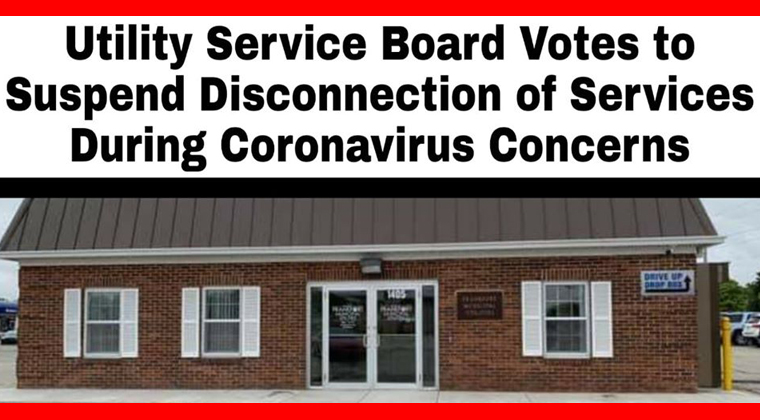
[Frankfort Utilities Service Board Votes To Suspend Service Disconnects Due To Non-Payment

During the Monday, March 16, 2020, Utility Service Board meeting, the USB took the step of voting 5-0 in favor to enact a suspension of service disconnects due to non-payment.

“The City of Frankfort Municipal Utilities have enacted a suspension of service disconnect due to non-payment.”

“This action will not only help customers who are facing a hardship due to lack of income during this time, but also limit in-person interactions between company employees and the public.”

“Customers who are unable to make monthly utility payments should contact the Billing Office at (765) 659-3361 to discuss deferring payments or to make other arrangements.”

“Frankfort Municipal Utilities will continue to monitor the coronavirus response situation and adjust the shutoff policy in the future as circumstances develop.”

The USB also suggested that those customers who do not want to come inside the building may use the drive-up window and conduct business from the comfort of their car.

Go to Top