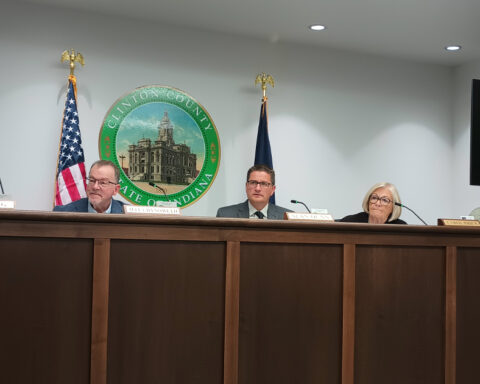
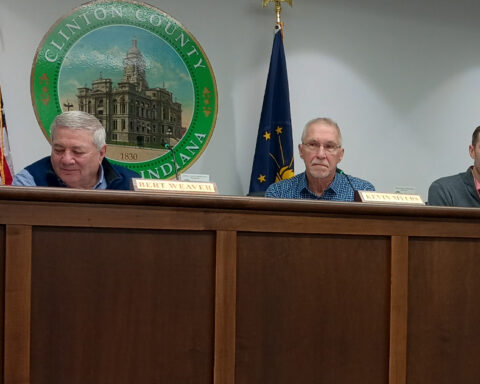
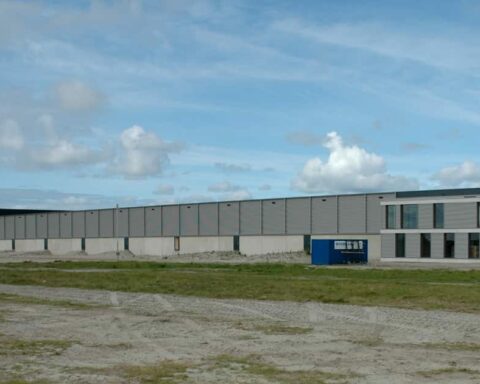
FRANKFORT, Ind. (September 2, 2025) — The Clinton County Area Plan Commission has opted to send a “no” or “neutral” recommendation to the Clinton County Commissioners regarding a contentious request by Logix Reality LLC to rezone a 154.92-acre agricultural parcel for a potential data center. The decision was reached after a lengthy public hearing at the Clinton County courthouse this evening.
The application, CC-2025-00787 (Docket # 15-25-RZ), sought to rezone land from the A-1 Agricultural Zoning District to the I-1 Light Industrial Zoning District. The proposed site is located on the south side of County Road 100 North, between 450 West and 300 West, in Washington Township. It is adjacent to a railroad and the ConAgra industrial park, with surrounding land zoned a mix of agricultural and industrial.
Liz Stitzel, Clinton County Area Plan Director, presented a detailed report outlining several considerations.
The staff report noted that the site’s location is appropriate for industrial zoning, given its adjacency to Frankfort’s corporate line, existing industrial areas, and the railroad. It also benefits from available sewer, water, and electrical capacity. The site is within a Tax Increment Financing (TIF) district, where development is anticipated to fund infrastructure improvements.
Significant concerns were raised about the readiness of drainage infrastructure, with no comfortable plan submitted to the county surveyor. County Road 100 North, a single-lane gravel road, was deemed insufficient for heavier or higher industrial traffic volumes, and no plan for its upgrade had been provided.
The report highlighted the need for plans to mitigate potential effects on four existing homes to the north and two legal non-conforming homes to the south that are currently zoned industrial.
A proposed new substation to the south, while not directly on the rezoning site, was noted as important for the project’s success, with questions about the acquisition of two legal non-conforming homes it would replace.
Staff initially recommended a one-month continuance to allow the applicant to address these critical information gaps. If no continuance, a nuanced negative recommendation was suggested, acknowledging comprehensive plan support but citing infrastructure unreadiness and unaddressed mitigation for incompatible uses.
Applicant’s case and public response made by John Moore, attorney for Logix Reality LLC, and Doug Swain of Logix Reality, emphasized the potential benefits of a data center.
Swain projected about $1.5 billion in investment, generating approximately $265 million in gross property tax revenue over 25 years and $6.3 million in local income tax. He estimated around 170 full-time employees with an average salary of $85,000 per year, noting a strong incentive for some to live locally, up to 35-percent of the workforce could live in the county.
Swain described data centers as a “cleanest, most simplest form of industrial,” producing no pollution, minimal noise (around 65 dB), and not much water use due to modern closed-loop cooling systems. He stressed that power would come from dedicated lines with costs borne by the developer/user, not local citizens.
The applicant’s representatives expressed willingness to work on drainage, improve County Road 100 North, provide buffering beyond ordinance requirements for residents, and limit certain industrial uses on the site. Swain apologized for not contacting residents earlier, acknowledging it was a mistake.
Swain stated the primary tax incentives are state-granted sales and use tax exemptions for equipment, which is state revenue, not local. He stated that Logix Realty LLC has not approached city and county officials regarding property tax abatements. However, he acknowledged that the end users might ask for local property tax abatements given the large investment.
The meeting saw a turnout of approxiamtely 125 residents with strong public opposition and concerns.
Residents expressed a desire to preserve the land as farm ground and emphasized Clinton County’s identity as a “farming community.” Concerns about water supply were prominent, with fears of wells running dry and the non-recyclable nature of water used. Electricity burden and potential brownouts were also cited.
Another resident claimed data centers produce about 92 dB of noise, comparable to a motorcycle. While another resident raised concerns about light pollution impacting the Prairie Grass Observatory.
Many speakers criticized the lack of information provided to the public and homeowners, stating they felt excluded from the process. Concerns were raised about tax abatements and the need for independent studies.
Two speakers argued that using public money for economic development, such as data centers, is unlawful and without constitutional authority, citing Supreme Court cases and state constitutions.
After hearing the comments from the public and the applicant, the Area Plan Commission first denied a motion for a 30-day continuance made by member Jeff Chynoweth for lack of a second. A subsequent motion to send a negative recommendation to the County Commissioners failed with a 3-1 vote, as four “yes” votes were required for action.
After further discussion on the options as presented by Stitzel, including the possibility of sending “no” recommendation, the board ultimately voted unanimously to pass a “neutral” or “no” recommendation to the County Commissioners. The County Commissioners, who have broader discretion in considering all factors, have 90-days to make a final decision on the rezoning request.
The next regularly scheduled meeting of the Clinton County Commissioners will be September 16th at 9 a.m. in the courthouse.